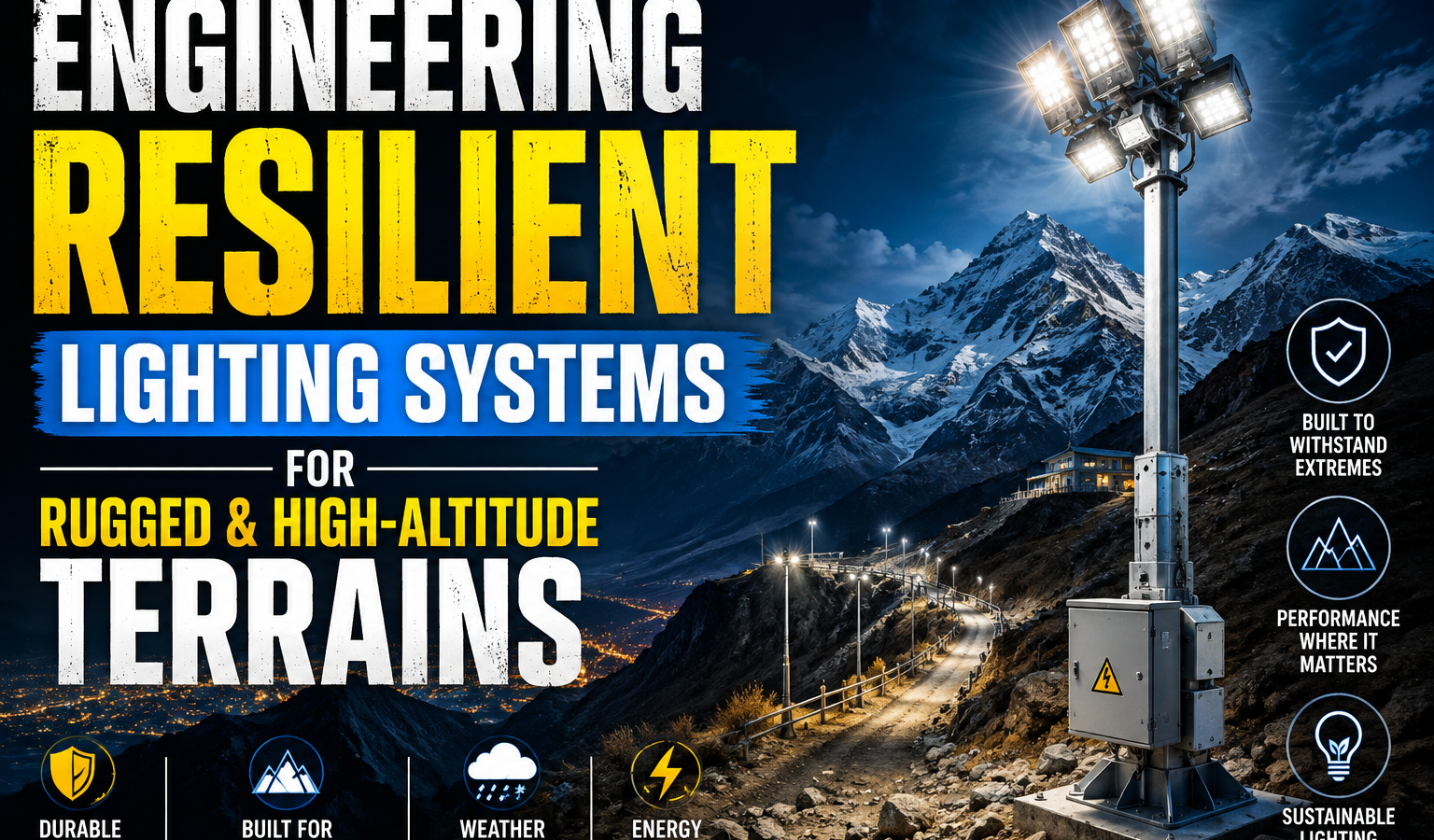
Lighting infrastructure built for the Gangetic plains simply does not survive unmodified in the Himalayan foothills or the Northeast hill states. Between landslide-prone slopes, sub-zero winter nights, near-constant monsoon moisture, and access roads that can be cut off for days, Weatherproof High Mast Pole Suppliers Himachal Pradesh, high mast installations in Himachal Pradesh, Uttarakhand, Meghalaya, Arunachal Pradesh, and Sikkim demand an entirely different engineering mindset than a flat highway stretch in the plains. For PWD engineers scoping these projects, the challenge isn’t finding a supplier who can install a pole — it’s finding one who understands why a standard pole specification will fail within a season.
The Core Problem: Terrain That Changes the Rules of Structural Engineering
On flat ground, a high mast pole’s structural challenge is almost entirely about wind load acting on a vertical column. In hill terrain, engineers have to account for several additional forces simultaneously: channelled wind acceleration through valley corridors, differential soil settlement on sloped foundations, and — in the most landslide-prone stretches — the possibility of gradual ground movement beneath the foundation itself over the structure’s service life.
Weatherproof High Mast Pole Suppliers Himachal Pradesh contracts routinely specify foundation designs that go beyond a standard concrete pad, incorporating deeper pilings or reinforced retaining structures on cut slopes to prevent the kind of slow foundation tilt that eventually compromises a pole’s vertical alignment — and with it, its photometric coverage pattern.
Anti-Corrosion Foundations for High-Moisture Hill Soil
Hill soil in high-rainfall belts — much of Himachal, Uttarakhand, and especially Meghalaya, which records some of the highest rainfall totals in the country — holds moisture against buried steel far longer than plains soil does. This accelerates corrosion at the base plate and anchor bolt level long before the visible above-ground pole shows any sign of wear.
Hill Terrain High Mast Lighting Meghalaya installations typically address this with a combination of measures: epoxy-coated anchor bolts, a raised concrete plinth that keeps the base plate itself clear of standing water, and drainage channelling around the foundation to direct runoff away from the structure rather than letting it pool at the pole base. Skipping this drainage detail is one of the most common reasons hill-terrain poles show premature base corrosion within five to seven years, well short of the 15-20 year design life expected on the plains.
Review HighMast India’s terrain-specific foundation approach on the Products page.
Thermal Management for LED Arrays in Extreme Cold
LED luminaires are generally more cold-tolerant than older lighting technologies, but extreme cold still affects driver circuitry performance and can, in poorly designed fixtures, cause condensation cycling inside the housing as temperatures swing between freezing nights and comparatively warmer daytime hours. Mountain Highway Lighting Contractors Sikkim and Mountain Highway Lighting Contractors Arunachal Pradesh projects — both operating in genuinely high-altitude conditions — typically specify luminaires with sealed, moisture-resistant driver compartments rated for a wider operational temperature band than standard plains fixtures, along with thermal design that prevents driver components from being damaged by repeated freeze-thaw condensation cycles.
Motorized Winch Safety Systems for Isolated Maintenance Routes
Perhaps the single biggest practical difference between plains and hill-terrain high mast maintenance is access. A maintenance crew servicing a pole on the outskirts of Jaipur can reach it in an hour with standard equipment. A crew servicing a pole on a remote stretch above Shimla, or on a border road in Arunachal Pradesh, may face a multi-hour drive, seasonal road closures, or terrain that makes bringing in a cherry-picker vehicle impractical.
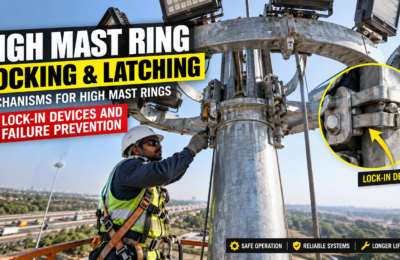
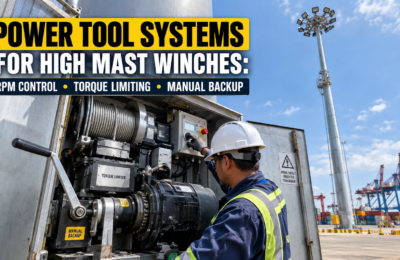
This is why Hill Terrain Highway Lighting Contractors Shimla projects lean heavily on motorized lowering ring mechanisms rather than fixed-head poles — the ability to lower the entire luminaire array to ground level for servicing, without needing specialized lift equipment, transforms a maintenance job that might otherwise require a multi-day expedition into a routine ground-level task. Given how infrequently some hill routes can be reached in winter months, minimizing the equipment burden for each maintenance visit has a direct, measurable impact on how quickly outages get fixed.
Landslide and Slope Stability Considerations in Foundation Placement
For PWD engineers scoping new installations along landslide-prone corridors — a real concern across much of Himachal Pradesh, Uttarakhand, and the Northeast hill states — foundation placement decisions increasingly involve slope stability assessment as a precondition, not an afterthought. Poles sited too close to a cut slope edge, or on fill material rather than stable cut ground, are at meaningfully higher risk of foundation compromise during heavy monsoon events.
Best practice in this terrain category is to treat each pole location as an individual geotechnical decision rather than applying a uniform spacing template borrowed from plains projects. This sometimes means adjusting planned pole positions by several metres from an initial survey line to reach more stable ground — a small design compromise that avoids a much larger structural failure risk later.
What Makes a Supplier Genuinely Hill-Terrain Capable
Not every high mast supplier that operates in the plains can execute reliably in hill terrain, and PWD teams evaluating vendors for Himachal, Uttarakhand, Meghalaya, Arunachal Pradesh, or Sikkim projects should look specifically for:
- Documented foundation designs adjusted for slope angle and soil moisture conditions, not a single standard foundation drawing reused everywhere
- Anchor bolt and base plate corrosion protection appropriate to high-rainfall conditions
- Luminaire driver specifications rated for the actual temperature range of the installation altitude
- Motorized lowering systems suited to low-equipment-access maintenance routes
- A track record of projects actually completed in comparable hill terrain, not just plains experience
Hill-terrain high mast lighting is fundamentally a different discipline from highway or industrial lighting on flat ground, and treating it as a smaller version of the same job is where most premature failures originate.
Logistics Planning: Getting Heavy Poles to Remote Sites
Before any structural discussion even begins, hill-terrain projects have to solve a basic logistics problem: how does a multi-metre steel pole section actually reach a site that may only be accessible by a single-lane hill road, with seasonal closures during heavy monsoon or winter snowfall? Mountain Highway Lighting Contractors Arunachal Pradesh projects routinely plan pole sectioning specifically around vehicle and road width constraints — using shorter, bolt-jointed pole sections that can be transported on standard hill-route trucks and assembled on site, rather than attempting to move a single continuous pole length that a hill road simply can’t accommodate. Planning this sectioning strategy at the design stage, rather than discovering a transport bottleneck after fabrication, avoids costly delays and re-fabrication.
Working Within Seasonal Access Windows
Many hill routes across Himachal Pradesh, Uttarakhand, Sikkim, and Arunachal Pradesh have genuine seasonal access windows — stretches that are difficult or impossible to reach safely during peak monsoon months or heavy winter snow. Project scheduling for Hill Terrain Highway Lighting Contractors Shimla work has to build installation phases around these windows rather than assuming year-round access, which affects everything from material staging to crew mobilization planning. Contractors with genuine hill-terrain experience typically front-load material delivery and foundation work into the accessible season, so that pole erection and commissioning can proceed even if a subsequent weather window narrows.
Frequently Asked Questions
Are hill-terrain high mast poles significantly more expensive than standard plains poles? Yes, typically — the combination of reinforced foundations, corrosion-rated components, sectioned transport-friendly pole design, and difficult-access installation labour generally raises total project cost per pole compared to a plains installation of similar height.
How often should hill-terrain poles inspect compare to plains installations? Given the accelerate corrosion risk from moisture and the structural risk from slope movement, most hill-terrain maintenance programs recommend more frequent visual and structural inspection intervals than would be standard for a comparable plains installation.
Power Supply Challenges in Remote Hill Locations
Grid power reliability in many hill routes across Himachal Pradesh, Uttarakhand, and the Northeast states is markedly less consistent than in plains regions, and lighting infrastructure has to be designed with this reality in mind. Voltage fluctuations are more common, and outages during heavy weather events tend to last longer given the practical difficulty of dispatching repair crews to remote grid infrastructure. Hill Terrain High Mast Lighting Meghalaya projects increasingly pair standard grid connections with solar-assisted or battery backup systems specifically to maintain lighting continuity through the outage windows that are simply more frequent in this terrain than on the plains. For genuinely isolated stretches with no practical grid connection at all, fully solar-powered high mast systems have become a realistic alternative rather than a niche option, particularly as solar panel and battery costs have continued to decline.
To discuss terrain-specific engineering for a hill route project, reach out through HighMast India’s Industries page or review compliance standards on the About page.