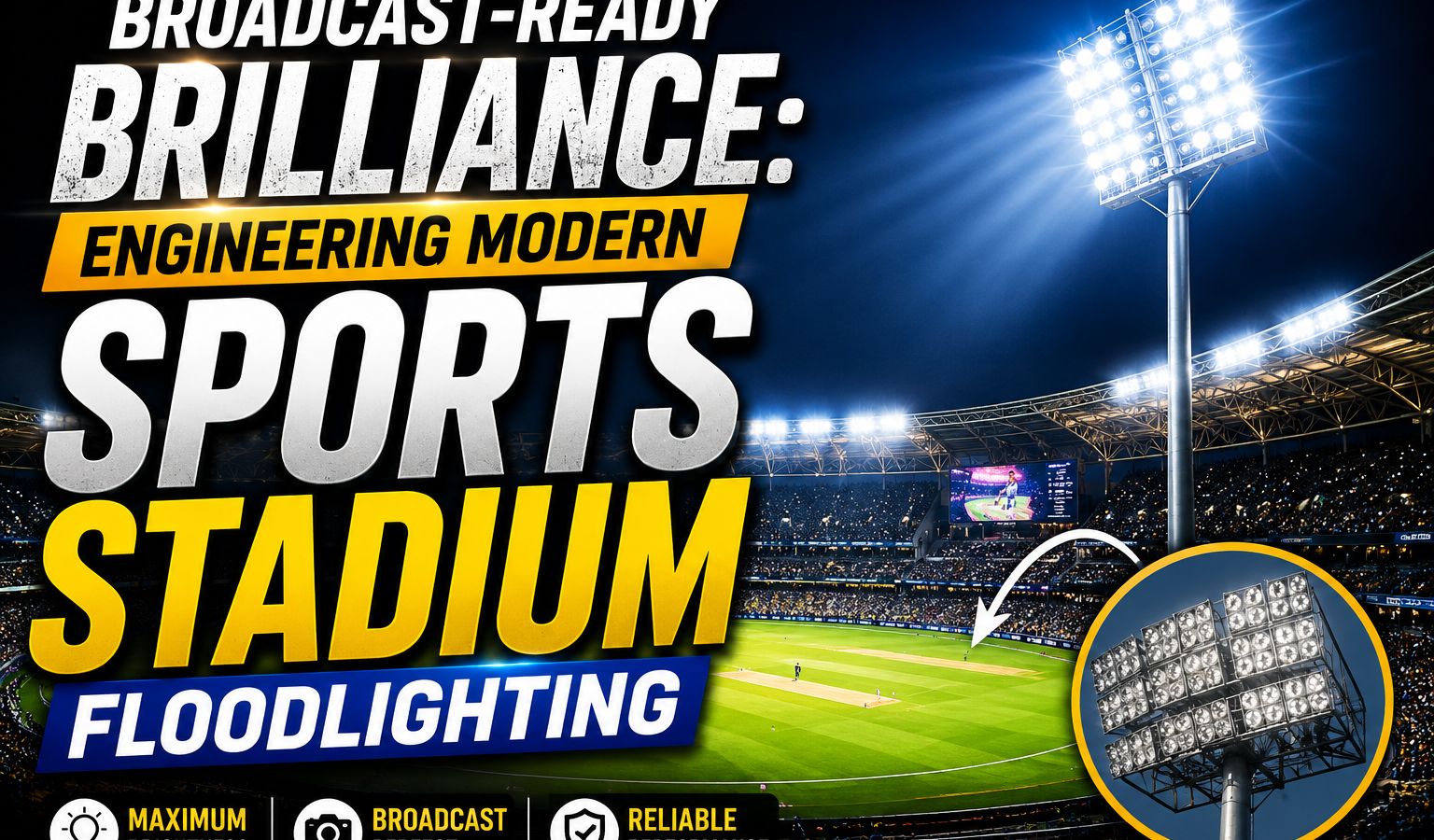
Stadium floodlighting has quietly become one of the most technically demanding applications in the entire high mast industry, largely because the audience for the lighting isn’t just the players and spectators in the Stadium Floodlighting Contractors Rajkot— it’s a television broadcast camera that will expose every inconsistency in colour temperature, flicker, and uniformity to a viewing audience far larger than the stadium itself. For sports associations and school or university project engineers commissioning new floodlighting across Rajkot, Punjab, Tamil Nadu, and Telangana, the specification bar has risen considerably in just the last several years.
Meeting Broadcast-Grade Lux Consistency
A stadium that looks adequately lit to the naked eye can still fail broadcast quality standards if lux levels vary significantly across the playing surface. Television cameras, unlike the human eye, don’t automatically compensate for uneven illumination — a pitch with strong lighting at the centre but noticeably dimmer coverage near the boundary will show up clearly on broadcast footage as an inconsistent, unprofessional-looking playing surface. Stadium Floodlighting Contractors Rajkot projects targeting venues with broadcast ambitions typically specify uniformity ratios considerably tighter than what would be acceptable for a purely recreational, non-broadcast facility, along with colour temperature consistency across every luminaire in the array so that camera white-balance doesn’t shift oddly as it pans across the field.
Precision Angles That Prevent Blinding Glare for Players and Fans
Beyond broadcast concerns, floodlighting has a direct player-safety dimension: poorly angled floodlights can create genuine glare interference for players tracking a ball at height, particularly in sports like cricket where fielders and batters are frequently looking upward at exactly the angle a badly positioned floodlight might occupy. Sports Stadium Floodlight Contractors Ludhiana and Sports Stadium Floodlight Contractors Punjab projects address this through careful beam angle modelling that accounts for the specific sport being play and the typical sightlines involved — a football-focused venue and a cricket-focused venue have meaningfully different glare risk profiles given the different directions players look during play, and floodlight positioning should reflect that difference rather than applying a generic “sports lighting” template regardless of the sport.
Structural Engineering for Towering Stadium Light Poles
Stadium floodlight poles are frequently among the tallest structures on any given sports campus, and they carry a substantial concentrate load at the top in the form of multiple floodlight fixtures mount in an array, rather than the more modest single or dual luminaire load typical of a highway or industrial pole. This changes the structural engineering calculus considerably — wind load on both the pole itself and the floodlight array mounted at height needs careful modelling, since a poorly braced floodlight bank at the top of a tall pole represents a significant point load that can induce vibration or sway under wind conditions that a simpler single-luminaire pole would handle without issue.
Stadium Light Pole Maintenance Tamil Nadu contracts increasingly include periodic structural vibration monitoring for taller stadium poles specifically because this vibration risk, if left unaddressed, can accelerate fatigue at welded joints and bolt connections over the pole’s service life in ways that aren’t always visible during a standard visual inspection.
Configuring Multi-Sport Lighting on a Budget
Not every facility commissioning floodlighting is building for broadcast-quality international competition. Many Stadium Floodlighting Systems Telangana projects serve school, university, or community-level multi-sport facilities where the same field hosts football, athletics, and other activities at different times, and budget constraints are considerably tighter than a professional stadium project would face. For these facilities, a practical compromise is specifying a lighting layout designed around the field’s most lighting-demanding regular use case, rather than the rare high-profile event that might justify broadcast-grade specification — this keeps installation cost proportionate to actual regular usage while still leaving reasonable headroom for occasional higher-profile events.
Lowering Installation Costs With Smart Pole Sourcing and Foundation Templates
Facilities working with constrained community or educational budgets can meaningfully reduce total project cost by standardizing on common pole heights and foundation designs across multiple installations, rather than custom-engineering each pole individually. Suppliers who maintain pre-engineered foundation templates for standard stadium pole heights and wind load classes can typically deliver faster and at lower cost than a fully bespoke engineering approach for every single project, provide the site’s actual wind load conditions fall within the range the standard template was design for.
Preventive Upkeep Schedules That Maximize Community Lighting Investment
Community and educational sports facilities often don’t have the dedicated facility maintenance staff that a professional stadium would employ, which makes a clearly defined, low-complexity preventive maintenance schedule especially valuable. A basic annual inspection covering luminaire cleaning, structural bolt-torque verification, and control panel checks — scheduled ahead of the facility’s peak usage season — helps these facilities avoid the kind of deferred-maintenance deterioration that eventually requires a far more expensive full system overhaul.
What to Specify When Commissioning Stadium Floodlighting
Sports associations and project engineers preparing a floodlighting brief should clarify:
- Whether broadcast-grade uniformity and colour consistency standards apply, or whether a more relaxed recreational-grade specification is appropriate for the facility’s actual use case
- Sport-specific beam angle modelling reflecting the primary sport or sports the facility will host
- Structural wind load and vibration considerations appropriate to the pole height and floodlight array weight being specified
- A realistic ongoing maintenance plan matched to the facility’s actual staffing and budget capacity
Weather and Seasonal Considerations for Outdoor Stadium Lighting
Stadium floodlighting systems, being fully expose outdoor installations, face the same environmental durability considerations cover elsewhere in this series — corrosion resistance for coastal or high-humidity venues, wind load appropriate to the region, and drainage design that prevents water accumulation around foundation bases. Stadium Floodlighting Systems Telangana venues hosting matches through the monsoon season specifically benefit from pre-monsoon inspection routines similar to those adopted for SEZ and industrial facilities, checking enclosure seals and drainage before peak rainfall rather than discovering a moisture-relate fault mid-season when a match is schedule.
Balancing Aesthetics With Function at Community-Scale Venues
Even budget-conscious community facilities increasingly consider the visual impression floodlighting poles make on the broader campus or neighbourhood, particularly for school and university venues where the sports facility is a visible part of the institution’s public image. This doesn’t necessarily mean a significant cost premium — thoughtful pole placement and cable routing that avoids an unnecessarily cluttered look can improve a facility’s visual presentation without requiring the premium architectural treatment a professional stadium might invest in.
Frequently Asked Questions
What lux level is typically require for a broadcast-quality cricket or football venue in India? Exact lux requirements vary the specific broadcast standard and competition level involved, and are usually detail in the governing sports body’s venue lighting guidelines; facilities should confirm the applicable standard with their sport’s national association before finalizing a lighting brief.
Can existing stadium floodlighting be upgrade to LED without replacing the poles themselves? Where the existing pole structure and mounting brackets are confirmed structurally sound and rate for the new luminaire weight, LED retrofitting on existing poles is generally practical and considerably more cost-effective than full pole replacement.
How far in advance of a schedule match or event should floodlighting maintenance complete? Most venues schedule a full functional and visual inspection at least a few weeks ahead of any high-profile schedule event, allowing enough time to source and install replacement components if an issue is discovere, rather than risking a last-minute scramble immediately before kickoff.
Coordinating Multiple Contractors on a Single Venue Project
Larger stadium projects often involve separate contractors for civil construction, seating and stand infrastructure, and floodlighting, and coordinating cable routing and foundation work between these teams requires clear sequencing to avoid costly rework. Sports Stadium Floodlight Contractors Ludhiana projects working alongside separate civil contractors typically confirm foundation and conduit routing plans before either team breaks ground, since retrofitting cable routes around already-completed stand construction is considerably more disruptive and expensive than planning the sequence correctly from the outset. Establishing a single shared project timeline document that all contractors reference, rather than each team working from their own independently maintained schedule, has proven to be one of the simplest and most effective ways to avoid this kind of costly sequencing conflict.
Stadium lighting will keep evolving as broadcast expectations rise and community facilities look for cost-effective ways to keep pace, but the fundamentals — accurate uniformity modelling, sport-specific glare control, and sound structural engineering at height — remain the foundation every successful project is built on.
To discuss floodlighting specifications for a stadium or multi-sport facility project, connect with HighMast India through the Products page.