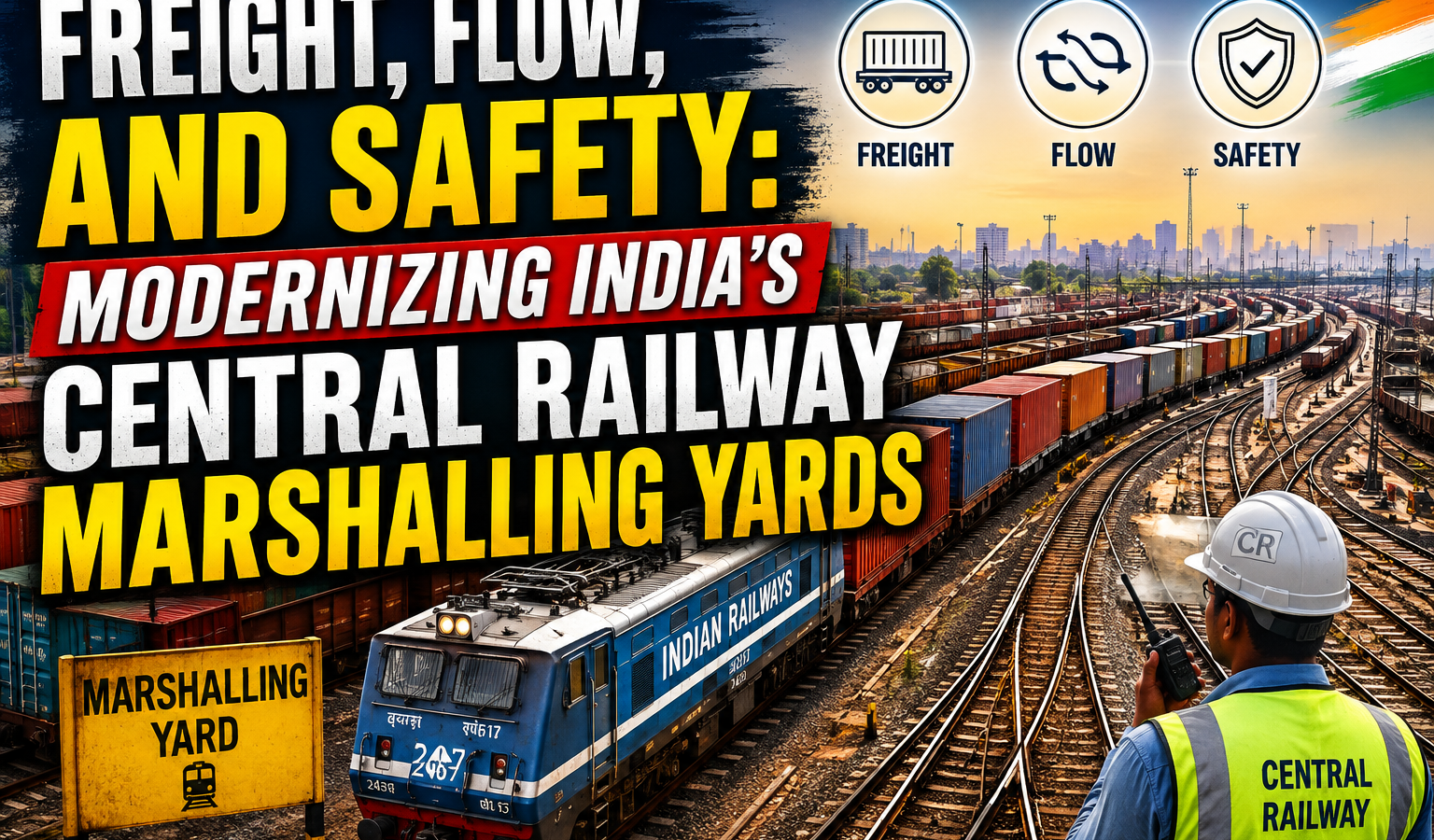
Railway marshalling yards operate under a lighting challenge that few other infrastructure categories share: multiple parallel tracks, constantly shifting rolling stock, overhead electrification infrastructure, and shunting operations that continue around the clock regardless of weather or season.Kanpur Railway Yard Lighting Systems For railway engineering contractors bidding on yard lighting modernization across Kanpur, Madhya Pradesh, Patna, and Gaya, getting the photometric layout wrong doesn’t just create a dim yard — it creates genuine operational and safety risk for staff working between moving rolling stock in low visibility.
Why Marshalling Yards Are a Uniquely Difficult Lighting Environment
A standard industrial yard has predictable traffic patterns and largely static infrastructure. A marshalling yard has neither. Multiple tracks run parallel at close spacing, rolling stock height and profile vary significantly between freight wagon types, and shunting movements happen in both directions across a layout that can span a considerable area. Kanpur Railway Yard Lighting Systems projects have to account for all of this simultaneously — a lighting layout optimized for a single track configuration can create significant shadow zones once multiple wagon types are actually present on adjacent tracks.
Overcoming Lighting Challenges Across Multi-Track Shunting and Sorting Lines
The core photometric challenge in yard lighting design is that rolling stock itself becomes a moving obstruction to light distribution. A high mast tower positioned to light one track cleanly may cast a significant shadow onto the adjacent track once a tall freight wagon is present between the light source and the target area. Railway Yard Lighting Contractors MP projects addressing this typically use a combination of taller mounting heights — which reduces the shadow angle cast by rolling stock — and closer pole spacing along multi-track sections specifically, compared to the pole spacing that would be adequate for a single-track approach or departure line.
Choosing Asymmetric Beam Configurations to Reduce Shadows Under Freight Cars
Beyond mounting height and spacing, luminaire beam configuration itself plays a significant role in minimizing shadow zones beneath and between freight cars — areas where staff frequently need to work during coupling, inspection, or brake-testing operations. Asymmetric beam luminaires angled to throw light along the length of the track, rather than straight down, help fill in the shadow area beneath rolling stock that a purely vertical beam pattern would leave dark. Railway Yard Lighting Contractors Patna projects handling significant freight volume have increasingly adopted this angled-beam approach specifically in response to safety audit findings around under-wagon visibility during coupling operations.
Using Lowering Mechanism Configurations to Avoid Working Near Overhead Lines
Railway yards present a maintenance access challenge that most other high mast applications don’t share to the same degree: overhead electrification infrastructure running above or near the track area creates a genuine safety constraint on how maintenance crews can access lighting fixtures. Standard elevated-access maintenance methods that would be routine at a highway or industrial site can create dangerous proximity to live overhead lines in a railway yard context.
This is why motorized lowering ring mechanisms have become close to a standard specification for yard lighting poles positioned near electrified track sections — bringing the luminaire array down to ground level, safely clear of overhead line proximity, before any maintenance work begins. High Mast Pole Installation Services Gaya projects serving electrified yard sections specify this lowering capability as a baseline requirement rather than an optional upgrade, given the safety stakes involved in any alternative access method near live overhead infrastructure.
Coordinating Installation Around Continuous Yard Operations
Marshalling yards, much like ports, rarely have the luxury of a full operational shutdown to accommodate a lighting infrastructure project. New pole installation and foundation work has to be sequenced around active shunting schedules, typically coordinated closely with yard operations control to identify windows where a specific track or section can be temporarily closed to rolling stock movement without disrupting the yard’s overall freight throughput. Contractors experienced in railway yard work build this coordination directly into their project planning and pricing, since the schedule flexibility required is considerably tighter than a comparable industrial site project would demand.
Weatherproofing Considerations for Yards Operating Through Monsoon and Fog Seasons
Beyond the structural and photometric challenges already covered, yard lighting infrastructure across the Kanpur, MP, Patna, and Gaya region has to remain reliably functional through both monsoon flooding risk and, in northern winter months, dense fog conditions that already reduce visibility significantly before any lighting deficiency compounds the problem. Foundation drainage design that prevents water pooling around control panel bases, and control systems with reliable automatic operation that doesn’t depend on manual switching during reduced-visibility fog conditions, are both standard specification expectations for yard lighting contracts in this climate zone.
The Growing Role of Remote Monitoring in Yard Lighting Management
As railway freight operations increasingly digitize broader yard management systems, lighting infrastructure that can report operational status remotely — flagging a failed luminaire or a control panel fault without requiring a physical walk-through inspection — offers a genuine operational advantage over yards still relying entirely on visual inspection to catch outages. Given how large a marshalling yard’s physical footprint can be, and how safety-critical consistent lighting is to ongoing shunting operations, remote fault reporting capability has moved from a nice-to-have feature to something increasingly specified as standard in newer railway yard lighting tenders.
Specification Considerations for Contractors Bidding on Railway Yard Tenders
Railway engineering contractors preparing bids for yard lighting modernization across Kanpur, MP, Patna, or Gaya should prepare to demonstrate:
- Photometric modelling that accounts for shadow effects from realistic rolling stock profiles, not an empty-track assumption
- Mounting height and pole spacing calculations specific to multi-track shunting sections
- Asymmetric beam luminaire specifications addressing under-wagon visibility for coupling and inspection work
- Motorized lowering mechanisms as standard for any pole positioned near overhead electrification infrastructure
- A realistic installation sequencing plan coordinated around continuous yard operations rather than assuming unrestricted access
Training Yard Staff Alongside Infrastructure Upgrades
A lighting upgrade delivers its full safety benefit only when yard staff are briefed on any changes to visibility patterns or maintenance access procedures that come with the new system — particularly where a project introduces motorized lowering mechanisms that change how maintenance work near overhead lines is conducted going forward. Contractors delivering Railway Yard Lighting Contractors MP and comparable projects increasingly include a short staff orientation session as part of project handover, covering the practical operational differences between the old and new lighting systems, rather than assuming the safety benefit of the upgrade is self-evident to staff without any explanation of what has actually changed.
Frequently Asked Questions
Safe clearance distances are governed by railway electrical safety standards specific to the voltage class of the overhead system, and should always be confirmed with the relevant railway electrical engineering authority before finalizing pole placement, rather than assumed from general industrial clearance norms.
Do railway yard lighting contracts typically require railway-specific vendor approval separate from general PWD or municipal contractor registration? Yes — railway infrastructure work generally requires vendor empanelment or approval specific to railway engineering standards, which is a separate qualification process from state PWD or municipal contractor registration and should be confirmed early in the tender preparation process.
How do fog conditions in North Indian winters affect yard lighting specification beyond standard photometric design? Dense winter fog scatters light in ways that reduce the effective visibility gain from simply increasing lux levels, which is why yard lighting design in fog-prone regions increasingly pairs standard high mast coverage with lower-mounted, more localized lighting at critical coupling and inspection points, rather than relying solely on elevated area lighting to maintain visibility during heavy fog events.
Who typically owns the maintenance responsibility for yard lighting once a modernization project is handed over — the railway authority or the installing contractor? This is generally define in the original tender contract terms, with many projects including a define warranty and initial maintenance period handle the installing contractor before responsibility transitions to the railway authority’s own maintenance staff or a separate AMC arrangement.
Looking Ahead: Freight Growth and Infrastructure Readiness
India’s central and eastern rail freight corridors are expect to see substantial volume growth over the coming years as dedicate freight corridor infrastructure comes online and industrial output in the served regions continues expanding. Yard lighting infrastructure install today needs to specifie with this growth trajectory in mind — control panels and cabling infrastructure with reasonable spare capacity for future pole additions, rather than a system sized precisely to today’s track configuration with no room for the yard’s likely future expansion.
As freight volumes continue growing across India’s central rail network, yards that modernize their lighting infrastructure proactively — rather than waiting for a safety incident to force the issue — are position to handle that growth without the operational disruption a reactive, incident-driven upgrade project inevitably brings.
Learn more about HighMast India’s approach to complex operational-environment lighting on the Products page.