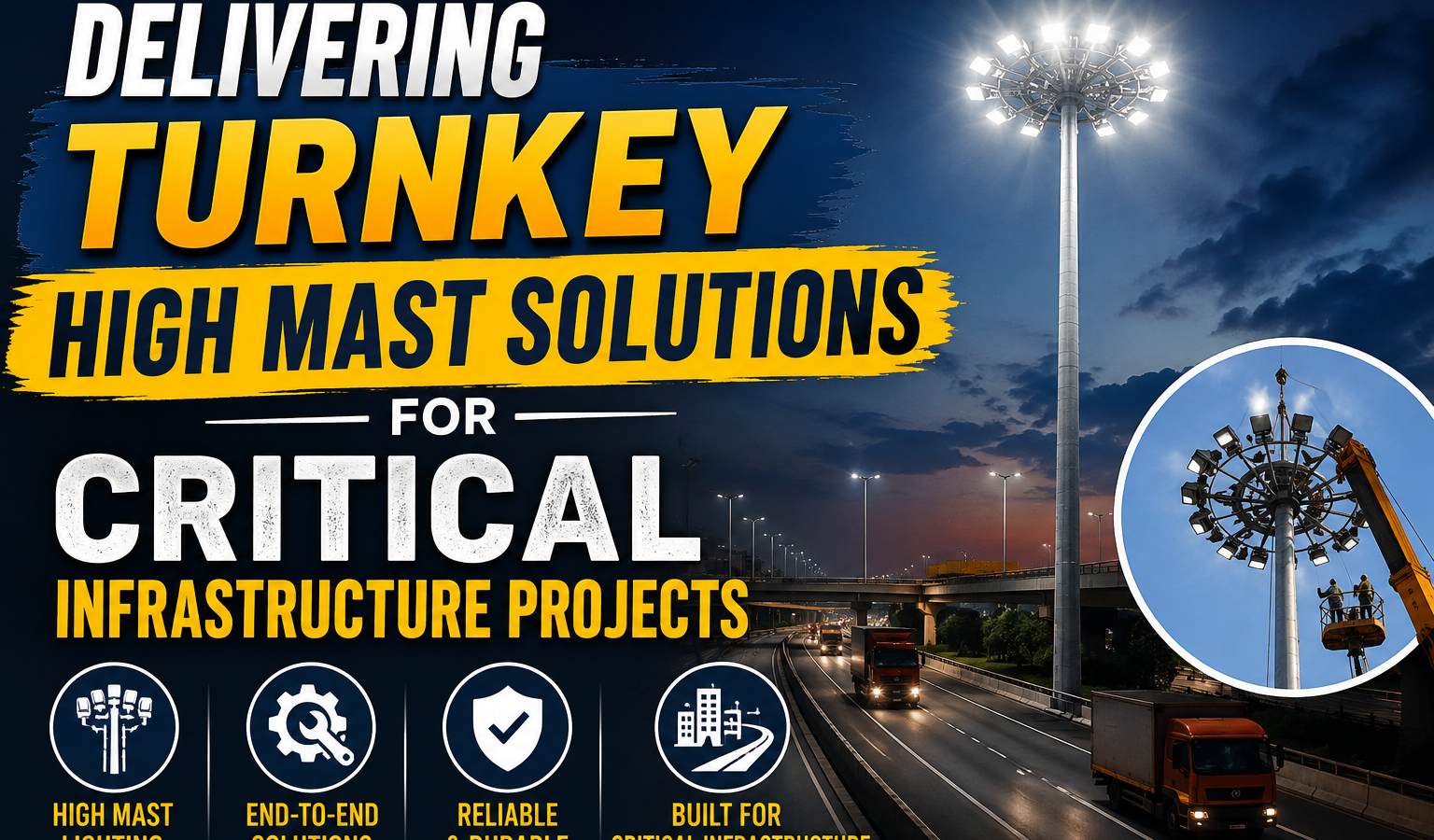
Turnkey high mast delivery — where a single contractor manages everything from initial site assessment through final commissioning — has become the preferred procurement model for large construction groups working across diverse project types, from Tamil Nadu’s industrial installations to Mumbai’s dense urban infrastructure to Nagaland and Sikkim’s genuinely challenging hill terrain.High Mast Pole Turnkey Installation Tamil Nadu, The appeal is straightforward: a single accountable partner managing the full project lifecycle, rather than a construction group having to coordinate multiple separate specialist vendors across soil testing, foundation work, structural erection, and electrical commissioning themselves.
Managing the Full Project Lifecycle From Soil Testing to Startup
High Mast Pole Turnkey Installation Tamil Nadu projects that genuinely deliver on the turnkey promise start with proper site assessment — soil testing to confirm foundation design assumptions, and a site survey confirming the practical logistics of pole delivery and crane access before any fabrication begins. Skipping this initial assessment phase in favour of moving straight to fabrication base on generic site assumptions is a common source of costly rework later, when actual site conditions turn out to differ from what was assume at the proposal stage.
From there, a genuinely managed turnkey process carries through foundation construction, pole fabrication and delivery coordinated to match the foundation curing schedule, structural erection, electrical commissioning, and final photometric verification — with the turnkey contractor holding accountability for the coordination between each stage, rather than each stage being handled by a separate vendor with unclear responsibility for the handoffs between them.
Coordinating Heavy Crane Operations and Safety Protocols
High Mast Pole Erection Contractors Telangana and High Mast Pole Erection Contractors Mumbai work both involve genuinely complex crane coordination challenges, though for different reasons — Telangana’s larger industrial and SEZ sites often involve erecting multiple tall poles across an extended site in a coordinated sequence, while Mumbai’s dense urban environment frequently constrains crane positioning and access in ways that a more open industrial site wouldn’t face. Successful erection contractors in both contexts share a common practice: detailed lift planning that accounts for the specific site’s access constraints and surrounding structure clearances before crane mobilization, rather than assuming a standard lift plan will work at any site regardless of its specific layout.
Safety protocols during erection — exclusion zones beneath the lift path, clear communication procedures between crane operator and ground crew, and weather monitoring to avoid lifting in unsafe wind conditions — are non-negotiable regardless of site context, and turnkey contractors should be able to demonstrate a documented safety protocol they follow consistently across projects, not an improvised approach developed fresh for each site.
Delivering Turnkey Projects in Genuinely Difficult Terrain
High Mast Pole Erection Contractors Nagaland and High Mast Tower Installation Sikkim work brings the hill-terrain logistics and access challenges discussed elsewhere in this series directly into the turnkey delivery model — a single contractor managing the full project lifecycle in this terrain needs to account for seasonal access windows, sectioned pole transport for narrow hill roads, and foundation designs adjusted for slope conditions, all within a single coordinated project plan rather than treating these as separate specialist concerns bolted onto a standard turnkey process. Construction groups evaluating turnkey partners for hill-terrain projects specifically should confirm the contractor has genuine prior experience delivering complete projects in comparable terrain, not just experience with individual project phases in isolation.
Providing Full Technical Documentation at Project Completion
A properly delivered turnkey project concludes with comprehensive technical documentation handed over to the client — as-built drawings reflecting actual installed pole positions and specifications, photometric verification reports confirming the installed system meets the design brief, structural compliance certificates, and maintenance manuals covering the specific equipment installed. Construction groups should treat the completeness and quality of this handover documentation as part of their evaluation criteria when selecting a turnkey partner, since incomplete documentation at handover creates real problems for whoever takes on ongoing maintenance responsibility after the turnkey contractor’s involvement ends.
Pricing Structures and Risk Allocation in Turnkey Contracts
Turnkey contracts typically structure pricing and risk allocation differently from a straightforward supply-and-install arrangement, often including contingency provisions for site conditions that differ materially from the initial assessment, and clearly defined milestones tied to payment release. Construction groups negotiating turnkey agreements should pay particular attention to how the contract allocates risk for unforeseen site conditions — a well-structured contract defines this clearly upfront, rather than leaving it as a point of dispute if actual conditions differ from the initial site assessment once work is underway.
Post-Handover Support and Warranty Coverage
Beyond the initial project delivery, construction groups should clarify what warranty and post-handover support the turnkey contractor provides — coverage for structural or electrical defects discover within a defined period after handover, and whether ongoing maintenance support is available as a follow-on service or needs to separately arrange with a different provider. Projects in genuinely remote terrain, such as Nagaland or Sikkim installations, particularly benefit from a turnkey contractor who can also provide practical follow-on maintenance support, given how much more difficult it is to onboard an entirely new maintenance provider unfamiliar with the specific site after the original turnkey contractor’s involvement ends.
Communication and Progress Reporting During Multi-Phase Projects
Large construction groups managing turnkey high mast work as one component of a much larger project generally need regular, structured progress reporting from the lighting contractor to keep their own broader project schedule accurately updated. Turnkey contractors who provide clear, scheduled progress updates — flagging emerging risks early rather than only reporting problems once they’ve already caused a delay — make it considerably easier for the construction group’s own project management team to coordinate the lighting workstream against other parallel construction activities happening on the same site.
Evaluating Turnkey Partners Across Multiple Concurrent Sites
Construction groups managing large, geographically distributed portfolios — projects spanning Tamil Nadu, Telangana, Mumbai, and hill-terrain states simultaneously — benefit from evaluating whether a single turnkey partner can realistically support this full geographic spread, versus needing separate regional partners for genuinely distinct terrain categories. A contractor with strong industrial and urban erection experience isn’t automatically the right choice for a Sikkim hill-terrain site, and construction groups should resist the administrative convenience of a single national vendor if that vendor’s actual regional experience doesn’t genuinely cover every project type in the portfolio.
What to Look for When Selecting a Turnkey High Mast Partner
Construction groups evaluating turnkey high mast contractors should confirm:
- Genuine site assessment practice, including soil testing and access survey, before fabrication begins
- Documented lift planning and safety protocols for crane-based erection, consistently applied across projects
- Verified prior experience delivering complete projects in terrain comparable to the specific project site, particularly for hill-terrain or dense urban work
- Comprehensive handover documentation including as-built drawings, compliance certificates, and maintenance manuals
- A single point of accountability spanning the full project lifecycle, rather than fragmented responsibility across project phases
Frequently Asked Questions
How should a construction group evaluate whether a contractor’s turnkey claim is genuine versus a loosely coordinated set of subcontracted services? Asking for specific examples of how the contractor managed handoffs between project phases on comparable past projects — particularly how issues discovered during one phase were resolved without delaying the next — is a more revealing evaluation approach than simply confirming the contractor offers all the required services on paper.
Does turnkey delivery typically cost more than managing separate specialist vendors independently? Turnkey pricing often carries a modest premium over the sum of individually sourced specialist services, but this premium generally reflects the coordination risk the turnkey contractor is absorbing on the client’s behalf, and construction groups should weigh it against the genuine cost and risk of managing that coordination themselves.
What happens if soil conditions discover during foundation work differ significantly from the initial site assessment? A well-structure turnkey contract should define how this scenario is handle upfront, typically through a document change-order process with pre-agree pricing principles, rather than leaving the resolution to ad hoc negotiation once the discrepancy is discovered mid-project.
The construction groups that get the most value from turnkey high mast partnerships are the ones who evaluate contractors on demonstrate project-lifecycle accountability, not just headline pricing — since the coordination failures that turnkey delivery is meant to prevent rarely show up on a quote sheet, only in how smoothly (or badly) a project actually runs once work begins.
To discuss a turnkey high mast project for your site, connect with HighMast India through the Products page or Industries page.