
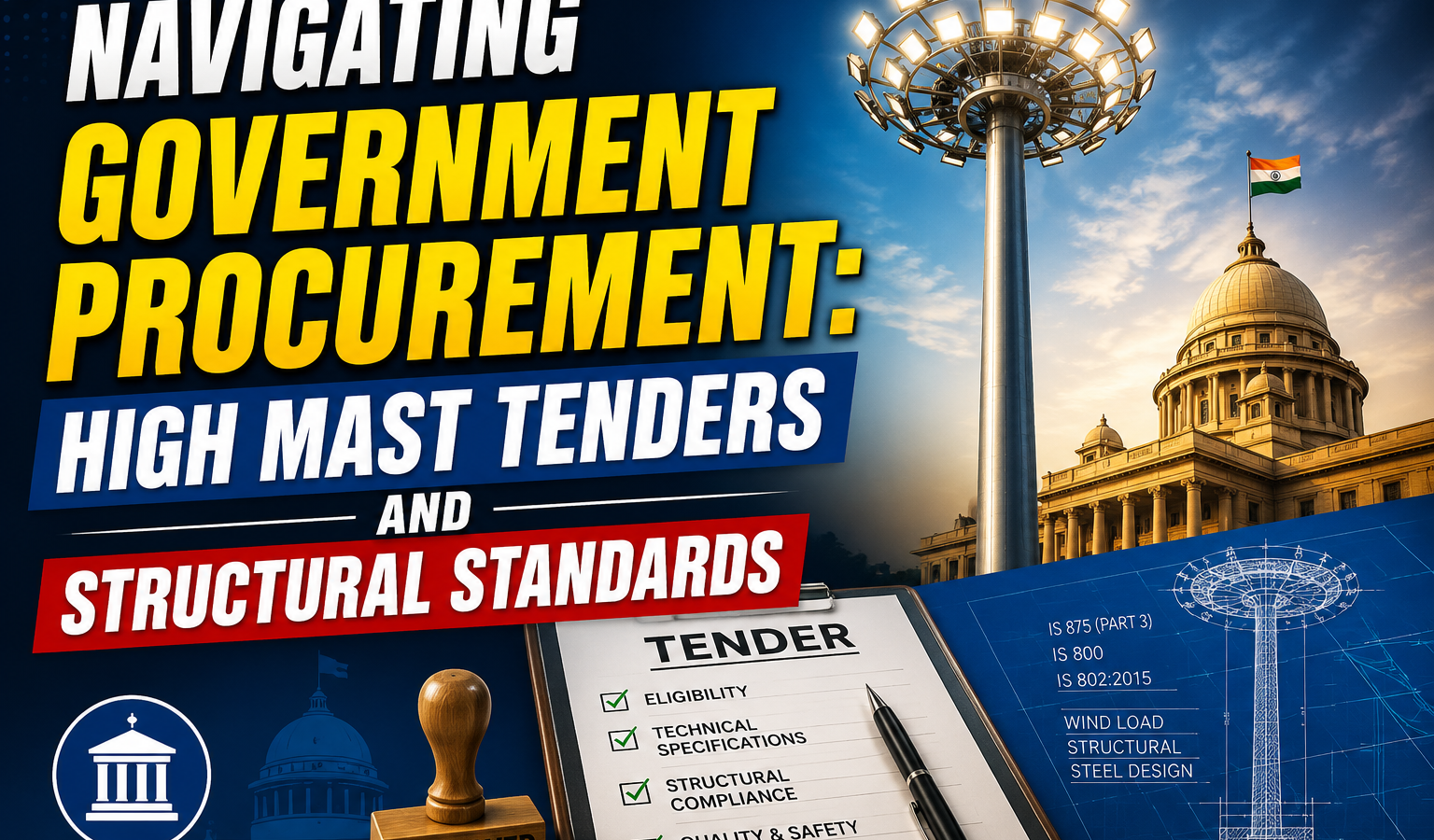
Government procurement for high mast lighting infrastructure runs on a fundamentally different logic than private commercial contracting, and B2B teams new to bidding on Rajasthan, High Mast Pole Tender Contractors Rajasthan, Madhya Pradesh, or Bihar PWD tenders often underestimate how much of the actual competition happens at the documentation and compliance stage, well before technical merit or pricing come into play.
Meeting Structural Rules and Material Certification for Government Jobs
High Mast Pole Tender Contractors Rajasthan and High Mast Pole Tender Contractors Bihar work is governed by structural and material specifications that reference national IS standards, but government tenders typically add their own documentation and testing verification layer on top of the base standard. This commonly includes third-party lab testing of material samples, batch-specific mill certificates rather than generic supplier specification sheets, and sometimes site-witnessed testing of galvanization thickness or structural load capacity before a tender is considered technically compliant. Bidders who submit generic manufacturer specification sheets in place of project-specific, batch-verified certification frequently find their bids disqualified at the technical evaluation stage, regardless of how competitive their pricing might be.
Step-by-Step Documentation for Public Sector Infrastructure Bids
MP PWD High Mast Pole Installation tenders, like most state PWD processes, generally require bidders to submit a structured documentation package covering company registration and financial standing, prior project experience with client completion certificates, technical compliance declarations against the specific IS standards referenced in the tender, and a detailed technical bid covering the actual proposed specification. Missing or incomplete documentation in any one of these categories is one of the most common reasons technically capable bidders are eliminated during the initial screening stage, before their actual technical proposal is even evaluated in detail.
Building a standing documentation library — company credentials, standard compliance certificates, and prior project completion records maintained in an organized, readily updatable format — considerably speeds up tender response time compared to assembling this documentation freshly for each new opportunity.
Balancing Cost-Effective Solutions With Structural Reliability
PWD High Mast Lighting Repair Rajasthan and comparable maintenance and repair tenders introduce a different tension than new installation work: government evaluation committees generally weigh cost competitiveness heavily, but bidders who cut corners on repair quality to win on price alone often find themselves facing repeat call-backs for the same fault, which damages their standing for future tender opportunities far more than a slightly higher initial bid would have. Contractors who build a track record of durable, first-time-right repair work tend to perform better in repeat tender cycles with the same PWD authority than those competing purely on lowest bid price.
Bihar’s Highway Infrastructure Push: Documentation at Scale
PWD Highway Lighting Infrastructure Bihar projects, reflecting the state’s ongoing highway infrastructure expansion, frequently involve multi-stretch contracts covering considerable distance and pole count, which raises the documentation and quality assurance stakes considerably compared to a single-site installation. Bidders on these larger-scale Bihar highway lighting tenders should be prepared to demonstrate not just technical compliance for a single representative pole specification, but genuine production and quality-control capacity to deliver consistent quality across potentially hundreds of poles on a coordinated installation schedule.
Common Reasons Technically Capable Bids Get Disqualified
Beyond the documentation gaps already discussed, several other recurring issues eliminate otherwise strong bids from government high mast tenders: submitting wind load calculations based on generic regional data rather than the specific location data the tender requires; providing galvanization specifications without the batch-specific mill test certificate the tender demands; and failing to account for tender-specific insurance or performance bond requirements that differ from a bidder’s standard commercial contracting practice. Reviewing the tender’s compliance checklist item by item, rather than relying on a standard company boilerplate response, catches most of these avoidable disqualification triggers before submission.
Building Long-Term Relationships With Repeat PWD Authorities
Contractors who successfully complete PWD tenders and build a reliable track record with a specific state authority often find subsequent tender cycles somewhat smoother, since evaluation committees do weigh documented past performance with their own authority when assessing new bids, even in a formally competitive tender process. Investing in first-time-right delivery quality on early contracts with a given PWD authority pays dividends in future tender competitiveness that a purely transactional, lowest-cost approach to each individual tender often misses.
Financial and Performance Bond Requirements
Government tenders typically require bidders to post performance bonds or bank guarantees as a condition of award, sized as a percentage of total contract value, along with retention amounts held back from progress payments until final handover and defect-liability period completion. PWD High Mast Lighting Repair Rajasthan and comparable tenders sometimes structure these requirements slightly differently for repair and maintenance contracts compared to new installation work, given the different risk profile involved, and bidders should confirm the specific financial requirements for each tender type rather than assuming a uniform requirement applies across all PWD lighting contract categories.
Timeline Realism and Mobilization Planning
Once a tender is award, the gap between contract signing and require project mobilization is often shorter than bidders anticipate, particularly for tenders tied to a broader infrastructure program with fix completion deadlines. Contractors bidding on Rajasthan, MP, or Bihar PWD work should have realistic mobilization plans already sketched out at the bid stage — material procurement lead times, crew availability, and site access coordination — rather than waiting until after award to begin this planning, since a slow mobilization start can consume a meaningful portion of an already tight project timeline before any actual site work begins.
Handling Variations and Change Orders During Execution
Even well-planned government contracts occasionally encounter site conditions or scope requirements that differ from the original tender specification, and how a contractor handles these variations matters considerably for both project outcome and future tender competitiveness with the same authority. Contractors who raise variation requests promptly, with clear supporting documentation of why the change is need, generally navigate this process more smoothly than those who either absorb unbudgete scope silently — creating financial strain that can affect execution quality — or who raise disputes only after significant work has already proceeded under the original assumption.
What B2B Teams Should Build Into Their Tender Response Process
Teams bidding on Rajasthan, MP, or Bihar PWD high mast tenders should maintain:
- A standing documentation library of company credentials, compliance certificates, and prior project records ready for rapid tender response
- Batch-specific material test certificates rather than generic manufacturer specification sheets
- Location-specific wind load calculations matched to the exact tender site rather than generic regional averages
- Demonstrated production and quality-control capacity for large multi-pole contract volumes where relevant
- A tender-by-tender compliance checklist review rather than relying on standard boilerplate documentation
Frequently Asked Questions
How long does the technical evaluation stage typically take for a state PWD high mast tender? Timelines vary state and tender complexity, but bidders should generally expect technical evaluation to take several weeks after the submission deadline before financial bids are open, and should plan their own project mobilization timeline with this evaluation period in mind.
Can a bidder request clarification on ambiguous tender specification language before submitting? Most PWD tender processes include a formal pre-bid query window specifically for this purpose, and bidders should use it actively — submitting a bid based on an incorrect assumption about ambiguous specification language is a common and entirely avoidable cause of later compliance disputes.
Does prior experience with one state’s PWD authority carry any weight when bidding in a different state? While each state authority evaluates bids independently, well-documented completion certificates and reference projects from other states generally still strengthen a bid’s technical credibility, even though they don’t substitute for meeting that specific state’s own documentation requirements.
Government procurement rewards contractors who treat documentation discipline as seriously as technical execution — the strongest technical proposal in the world won’t win a tender if it’s disqualified before evaluators ever reach the technical section. Teams that internalize this reality early, building compliance readiness into their standard operating practice rather than scrambling for each individual tender, consistently outperform competitors who treat documentation as an afterthought to their technical and pricing strategy.
To discuss compliance documentation support for a government tender, connect with HighMast India through the About page.