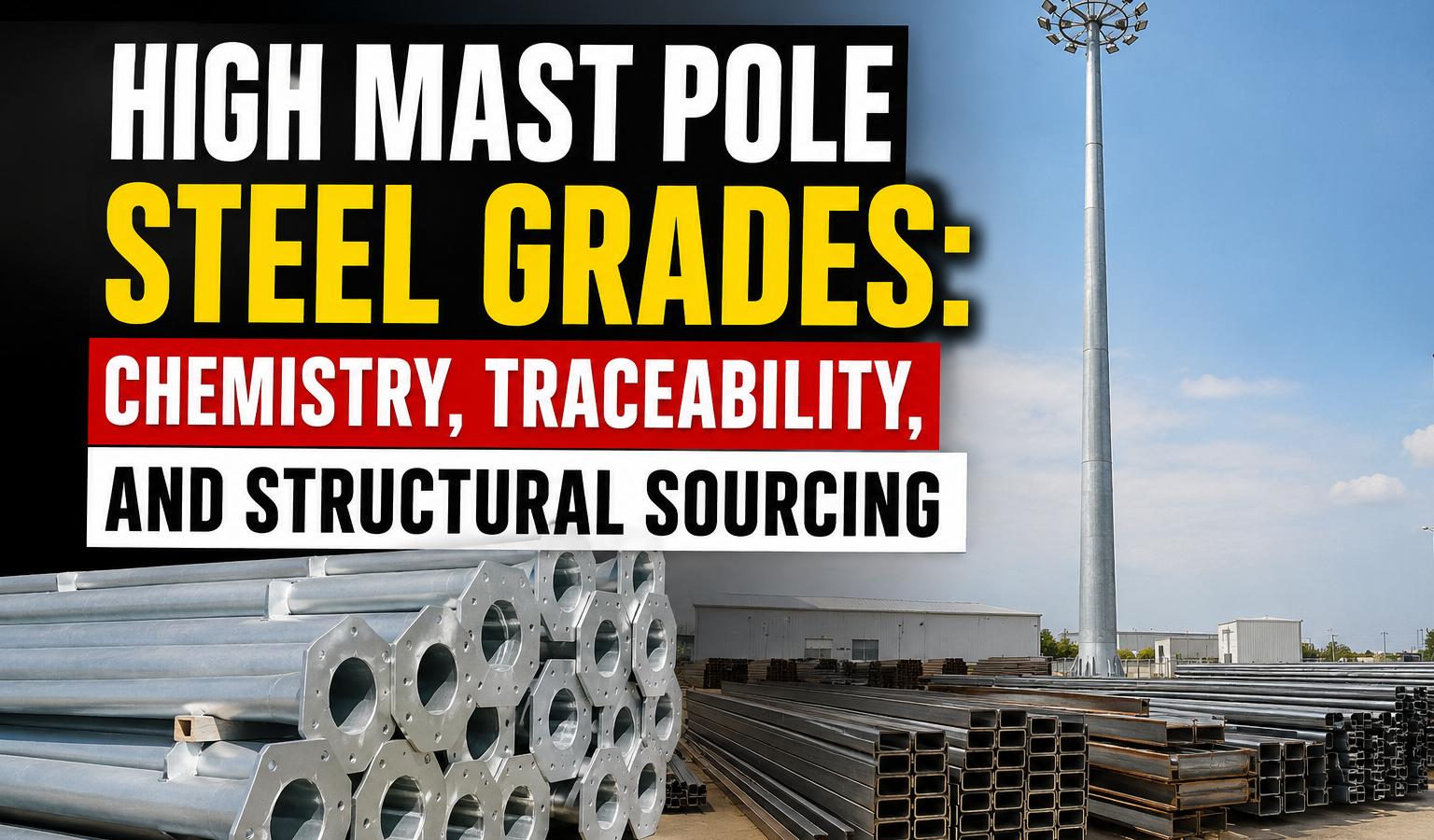
A high mast lighting pole is only as reliable as the coil of steel it was cut from. Fabricators who cut corners on raw material sourcing don’t fail on day one — they fail after five monsoons, when fatigue cracking finds every weld toe and every inclusion the mill certificate never mentioned. High Mast Pole Steel Grades, Procurement teams evaluating high mast tenders routinely focus on wall thickness, height, and luminaire count, while the underlying steel chemistry — the variable that governs galvanizing quality, weldability, and fatigue life simultaneously — gets a single line item on the BOQ.
This article breaks down exactly what tensile steel sheet specification, chemical composition, and mill traceability protocol a competent high mast manufacturer should working from, why each of these three variables directly governs the 25-30 year design life engineers price into a tender, and what a procurement officer should demanding in the technical bid documents before a single plate gets cut.
The three sections that follow move progressively from macro to micro: first the grade-level yield strength decision that shapes overall structural sizing, then the ladle-chemistry parameters that determine how that steel behaves once it enters the galvanizing kettle, and finally the paper trail that makes any of this verifiable rather than merely assumed. Skipping any one of these checks doesn’t just risk an isolated defect — it undermines confidence in the entire structural package, since a fabricator who is loose on traceability is statistically more likely to be loose on chemistry control as well.
What Grade of Tensile Steel Sheet Goes Into a High Mast Pole?
Most Indian high mast fabricators work from IS 2062 Grade B or Grade E350, while export-oriented shops calibrate to S355J2 under EN 10025-2. The choice isn’t cosmetic — it’s a yield-strength decision that ripples through every downstream calculation. Grade B (250 MPa yield) suits masts under 20m with moderate wind zones; anything above 25m, or sites in cyclone-prone coastal belts, typically demands E350 (350 MPa yield) to keep plate thickness — and therefore weight and foundation load — within economical limits.
Plate thickness for the base section of a 30m pole commonly runs 8-12mm, tapering to 4-5mm at the tip section. Specifying a higher yield grade lets the fabricator thin the plate without sacrificing the section modulus needed to resist bending moment at the base flange — the single most heavily stressed joint on the entire structure. The trade-off engineers weigh here is straightforward: a thinner, higher-grade plate costs more per tonne at the mill, but a thicker, lower-grade plate costs more in transport, crane capacity during erection, and foundation reinforcement to carry the extra dead weight.
There’s a second-order consideration that rarely makes it into the tender specification: plate thickness tolerance. IS 2062 permits a rolling tolerance band on nominal thickness, and a fabricator working consistently at the negative end of that tolerance is effectively delivering a lower safety margin than the design calculation assumed, even while remaining technically code-compliant. Asking for ultrasonic thickness verification on a sample of incoming plate is inexpensive insurance against this creeping deficiency.
Certified Chemical Composition: Why Silicon and Carbon Limits Matter
Chemistry decides how the steel behaves in the galvanizing kettle, not just under load. Silicon content is the parameter every fabricator should be watching closest, because it directly governs coating thickness and coating morphology during hot-dip galvanizing — an effect discovered decades ago and formally described in metallurgical literature as the Sandelin effect.
Steel with silicon in the 0.04-0.14% range, or above roughly 0.25%, produces excessively thick, brittle, dull-grey zinc coatings prone to peeling and mechanical damage during handling and erection. The sweet spot for predictable, adherent, bright coatings sits below 0.04% Si or between 0.15-0.25% Si — a narrow window that means the fabricator’s incoming steel chemistry has to be actively screened, not simply assumed compliant because it passed a generic mill grade.
Carbon content is capped independently — typically below 0.20-0.25% for IS 2062 grades — to preserve weldability. Higher carbon steel resists welding with excessive hardness in the heat-affected zone (HAZ), raising cold-cracking risk at the longitudinal seam described in Cluster 2. This is a compounding risk: a plate that’s borderline on both silicon (poor galvanizing) and carbon (poor weldability) can pass individual grade certification while still being a poor choice for a welded, hot-dip-galvanized structural application specifically.
Phosphorus, Sulphur, and Manganese: The Secondary Chemistry Checks
Beyond silicon and carbon, phosphorus is limited (commonly below 0.04%) because it promotes cold shortness — brittle fracture behaviour at lower temperatures, relevant for masts installed in northern India’s winter conditions. Sulphur is cap near 0.045% to avoid hot shortness during welding, where sulphide inclusions can cause cracking as the weld pool solidifies. Manganese, generally held between 1.0-1.6% depending on grade, is the element that balances strength against toughness, and its ratio to carbon content is itself a rough predictor of weldability that experienced fabrication engineers check informally even when it isn’t a hard specification line item.
Mill Test Certificates: Tracing Steel to Its Primary Producer
A genuine 3.1 Mill Test Certificate (MTC) per EN 10204, cross-referenced to the heat number stamped or painted on the coil, is non-negotiable for any project above 15m mast height. Reputable fabricators source plate directly from integrated producers — SAIL, Tata Steel, JSW, or equivalent — rather than from unregulated secondary re-rollers whose chemistry consistency and traceability discipline are far harder to verify.
Every MTC should list: heat/lot number, chemical composition from ladle analysis, mechanical properties (yield strength, ultimate tensile strength, elongation, and Charpy impact energy where specified for low-temperature service), and the rolling mill of origin. On a competitive tender, insist the fabricator’s quality dossier maps each finished pole section back to its heat number — this is what allows root-cause investigation if a fatigue failure ever occurs in service, and it is also what protects the fabricator from open-ended liability if a downstream failure turns out to trace back to a bad heat from the mill rather than a fabrication defect High Mast Pole Steel Grades.
In practice, many secondary-market steel traders will supply a ‘test certificate’ that is a generic document not tie to the specific coil deliver — sometimes photocopied or reused across multiple shipments. The only reliable check is matching the heat number physically mark on the plate or coil edge against the heat number print on the certificate; any mismatch, or any certificate lacking a heat number altogether, should treat as a rejection trigger regardless of how professional the document otherwise looks.
Steel Sourcing Economics and Lifecycle Cost Impact
Procurement teams frequently evaluate steel sourcing on a per-tonne landed cost basis alone, which systematically undervalues the lifecycle cost consequence of chemistry and traceability decisions made at the sourcing stage. A marginally cheaper coil from an unverified secondary source that later produces galvanizing rejects, weld cracking during fabrication, or — worse — an undetected fatigue-prone heat that only manifests as a field failure years into service, will always cost more across the asset’s 25-30 year design life than the incremental premium for verified, mill-traceable steel would have cost upfront.
This calculus becomes especially significant on large public infrastructure tenders — highway corridors, port lighting, stadium projects — where dozens or hundreds of masts share a common steel sourcing decision. A chemistry or traceability shortfall discovered late in one batch effectively puts the entire population of masts from that sourcing run under suspicion, forcing costly retrospective inspection or even replacement campaigns that dwarf any initial material cost saving.
Forward-looking specification writers increasingly build steel sourcing verification directly into payment milestones — releasing fabrication payment only after MTC verification against physically sampled heat numbers — rather than treating it as a document review exercise disconnected from the commercial process. This aligns the fabricator’s incentive with genuine traceability rather than paperwork compliance alone.
Comparative Technical Data Table
| Parameter | Recommended Limit | Consequence if Exceeded |
| Silicon (Si) | <0.04% or 0.15-0.25% | Thick, brittle, dull galvanized coating; peeling risk |
| Carbon (C) | <0.20-0.25% | Reduced weldability; HAZ cracking |
| Phosphorus (P) | <0.04% | Cold shortness; brittle fracture risk |
| Sulphur (S) | <0.045% | Hot shortness during welding |
| Manganese (Mn) | 1.0-1.6% (grade dependent) | Controls strength-toughness balance |
Practical Field Best Practices
- Reject any coil without a heat-number-linked 3.1 MTC — a generic ‘test report’ from a trader is not equivalent.
- For coastal or high-wind Zone V sites (per IS 875 Part 3), specify E350 or S355 minimum, not Grade B.
- Cross-check silicon content against the Sandelin curve before approving a heat for galvanizing, not after the fact.
- Retain MTC copies for the full design life of the asset — insurers and forensic engineers will ask for them decades later.
- Spot-check incoming plate thickness with an ultrasonic gauge rather than trusting nominal specification alone.
- Physically verify heat numbers on plate edges match the certificate before accepting a delivery batch High Mast Pole Steel Grades.
Summary Checklist
- Confirm tensile grade (IS 2062 / S355) matches the wind-zone and height calculation, not just cost.
- Verify Si and C limits fall inside the galvanizing-friendly window.
- Demand heat-traceable 3.1 MTCs from SAIL/Tata/JSW-tier producers.
- Archive certificates against each pole’s serial number for future forensic reference.
- Check phosphorus and sulphur limits for cold-region or high-fatigue applications.
- Verify plate thickness by independent measurement, not certificate alone High Mast Pole Steel Grades.