The wire rope on a high mast lowering system does two jobs nobody thinks about until it fails: it carries the entire luminaire ring’s weight through repeated flex cycles, and it does so inside a dark, largely inaccessible pole shaft where corrosion and wear go unnoticed between scheduled maintenance visits. Of all the components in a high mast system, wire rope is the one most commonly under-specified because it looks, superficially, like a commodity item High Mast Lowering Systems.
This section covers rope material, construction, and the inspection discipline needed to catch degradation before it becomes a dropped-ring incident — along with the practical realities of maintaining a component that spends its working life somewhere nobody can easily see it.
Wire rope failure is also one of the few high mast component failures with a well-documented, predictable degradation pathway — unlike a sudden brittle fracture, rope failure typically progresses through visible broken wires, diameter reduction, and corrosion staining over an extended period before reaching a genuinely critical condition. This makes wire rope inspection one of the highest-value, most preventable maintenance activities in the entire system, provided the inspection is actually performed with the rigor and frequency the component’s inaccessibility demands rather than the cursory glance it sometimes receives in practice.
Flexible Stainless Steel Rope with Independent Wire Rope Core (IWRC)
High mast lowering ropes are specified in Grade 316 stainless steel for corrosion resistance in an application where galvanized carbon steel rope would rust from condensation trapped inside the sealed pole shaft — a shaft that experiences daily temperature cycling and, in humid climates, near-constant condensation on interior surfaces regardless of external weather.
An Independent Wire Rope Core (IWRC) — rather than a fibre core — is standard, because IWRC construction resists crushing under sheave pressure and better maintains rope diameter and strength through repeated winch drum wrapping. A fibre-core rope’s core can compress and lose volume over years of cyclic loading, effectively reducing the rope’s working diameter and strength margin without any obviously visible external sign, which is precisely the kind of hidden degradation a system with infrequent inspection intervals cannot tolerate.
Grade 316 stainless (as opposed to the more common Grade 304) is specifically selected for its molybdenum content, which materially improves resistance to chloride-induced pitting corrosion — relevant both in coastal high mast installations and, less obviously, in the localized chloride exposure any galvanized steel shaft interior can develop from zinc corrosion byproducts over time.
Rope Construction: 6×37 vs. 7×19 for Flexibility
Construction notation (e.g., 6×37 or 7×19) describes strand count and wires per strand. 6×37 Class construction (6 strands, 37 wires each) is the common choice for high mast lowering ropes because the higher wire count per strand gives greater flexibility for repeated bending over the headframe pulley and winch drum, at a modest reduction in abrasion resistance compared to coarser constructions like 6×19 High Mast Lowering Systems q.
7×19 construction (7 strands including an independent wire rope core strand, 19 wires per strand) is an alternative offering even higher flexibility, often used where sheave diameters are particularly small relative to rope diameter — a common constraint inside compact headframe pulley housings where space is limited by the overall headframe design.
The general engineering principle governing this choice is the sheave-to-rope diameter ratio: smaller sheaves relative to rope diameter demand more flexible rope constructions to avoid excessive individual-wire bending stress each time the rope passes over the sheave, since bending fatigue in wire rope accumulates with every flex cycle over the rope’s service life, not just under static load.
Checking for Wear, Broken Strands, and Kinking Inside the Pole Shaft
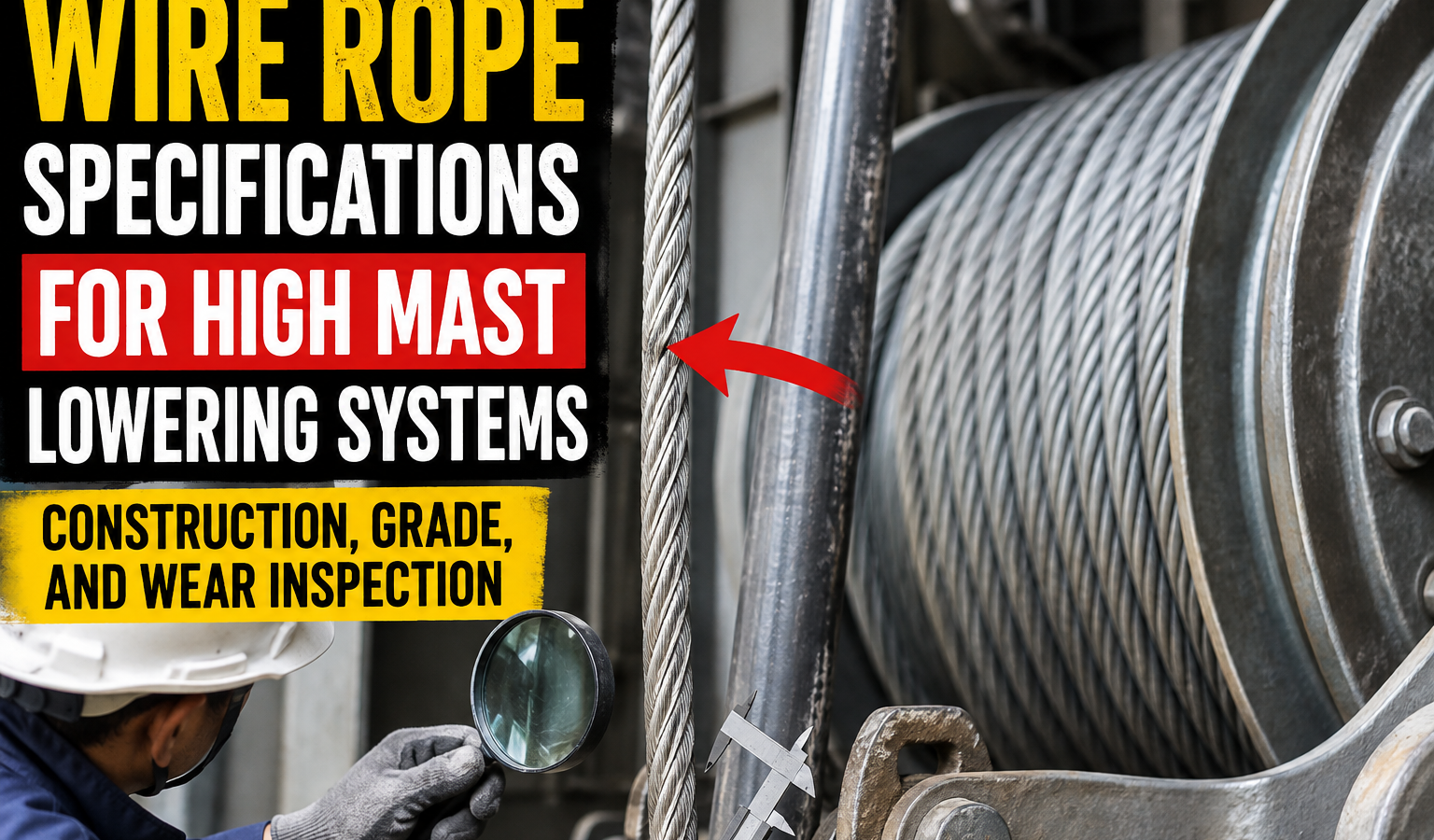
Because the rope runs largely hidden inside the mast shaft, inspection requires fully lowering the ring to expose the maximum rope length, then visually and manually running the rope through a gloved hand feeling for broken wire ends, checking for reduced diameter (a sign of internal wear or core failure), and looking for kinks, birdcaging (strand separation), or corrosion staining.
Rejection criteria commonly follow standards like IS 2365 or equivalent lifting-equipment codes: a define number of broken wires within one rope lay length, any core failure, significant diameter reduction (typically over 5-7%), or visible kinking triggers immediate rope replacement — not spot repair, since wire rope cannot locally repair in any way that restores its original load rating.
A practical inspection challenge specific to high mast systems: the section of rope that spends the most time flexing over the headframe pulley — and therefore accumulates the most fatigue damage — is not necessarily the section that’s easiest to access during a ground-level inspection with the ring lowered. Inspectors need to deliberately work the rope through several partial raise-lower cycles during inspection to bring the high-fatigue zone within reach, rather than only examining whatever length happens to expose at full lower position.
Rope Lubrication and Service Life Extension
Wire rope lubrication serves two distinct purposes that are easy to conflate: external lubrication reduces surface friction and abrasion against sheaves and drum, while internal lubrication (penetrating between individual wires and strands) reduces internal friction during flexing and displaces moisture that would otherwise promote internal corrosion invisible from the outside. A rope that looks well-lubricated externally can still be corroding internally if the lubricant used doesn’t penetrate the rope’s internal structure.
For stainless steel rope specifically, lubrication choice needs to account for the fact that stainless steel’s corrosion resistance comes from a passive oxide layer rather than a sacrificial coating — a non-tacky, penetrating lubricant formulated for stainless applications maintains this passive layer’s integrity and reduces fretting between individual wire strands, whereas a generic petroleum grease intended for carbon steel rope may not offer the same protection and can attract dust that abrades the rope surface over time.
Relubrication frequency should tied to actual operating cycles and environmental exposure rather than a fixed calendar interval alone — a mast in a high-dust industrial zone or a coastal salt-spray environment degrades lubricant film faster than one in a cleaner inland setting, and maintenance schedules that don’t differentiate by site condition either over-maintain low-risk sites or under-maintain high-risk ones High Mast Lowering Systems.
Comparative Technical Data Table
| Construction | Flexibility | Best Use Case |
| 6×19 | Lower | Larger sheave diameters, high abrasion zones |
| 6×37 | Moderate-High | Standard high mast lowering systems |
| 7×19 (IWRC) | High | Compact pulley housings, small sheave diameters |
Practical Field Best Practices
- Specify Grade 316 stainless with IWRC as default for all new high mast lowering installations.
- Match construction (6×37 vs 7×19) to actual headframe sheave diameter, not a generic default.
- Lower the ring fully for inspection at least twice yearly, running the full rope length through a gloved hand check.
- Replace the entire rope on any broken-wire, core-failure, or kinking finding — never attempt local repair.
- Cycle the ring through partial raises during inspection to bring the high-fatigue pulley-contact zone within reach.
- Verify sheave-to-rope diameter ratio meets manufacturer minimums before finalizing rope construction choice.
Summary Checklist
- Rope material confirmed as Grade 316 stainless steel with IWRC.
- Construction (6×37 or 7×19) matched to sheave diameter and flexibility need.
- Full-length physical inspection performed with ring fully lowered, on a fixed schedule.
- Any broken strand, core failure, or kink triggers full rope replacement.
- Inspection procedure includes cycling the rope to expose high-fatigue pulley-contact sections.
- Sheave diameter checked against rope construction manufacturer minimums High Mast Lowering Systems.