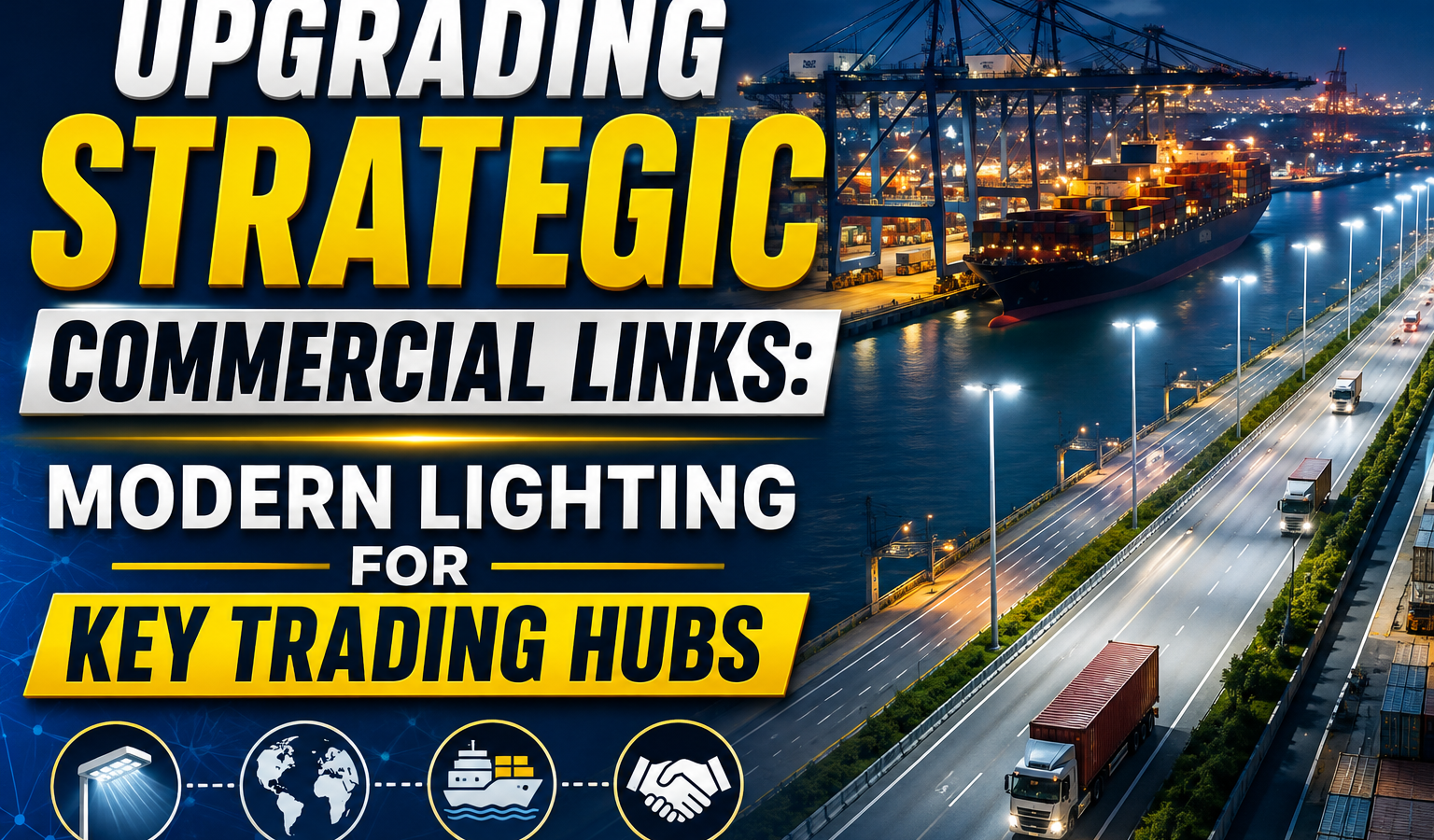
Trade corridors connecting Tripura, Bihar, and neighbouring regions serve a dual function that shapes their lighting infrastructure requirements — they need to support continuous commercial freight and passenger movement while, in border-adjacent areas like Tripura, also satisfying the security considerations discussed elsewhere in this series. For trade corridor project managers and transport depot operators, High Mast Light Pole Suppliers Tripura, this means lighting specifications often need to satisfy both commercial operational efficiency and security requirements simultaneously.
Ensuring Round-the-Clock Operations at Trading and Border Hubs
High Mast Light Pole Suppliers Tripura installations serving trade and transit hubs near the state’s international border need lighting infrastructure that supports genuinely continuous operations — commercial trading activity, customs processing, and the security monitoring discussed elsewhere in this series all depend on reliable, uninterrupted illumination. Facilities in this category generally cannot tolerate the kind of planned lighting downtime for maintenance that a less operationally critical facility might accept, which pushes maintenance planning toward the same redundant-zone, phased-servicing approach discussed for other continuously operating facilities in this series — servicing one zone while adjacent zones remain fully lit and operational, rather than any approach that creates even a temporary full-facility dark period.
Integrating Energy-Efficient Lighting Into Regional Transport Terminals
Agartala Smart City Lighting Infrastructure projects illustrate how the broader smart city modernization principles discussed elsewhere in this series apply directly to trade and transport terminal contexts — automated dimming during lower-activity overnight periods, remote fault monitoring, and energy-efficient LED specification all deliver the same operational cost benefits at a transport terminal that they deliver in a general municipal public lighting context, while still maintaining the higher security-relevant baseline illumination that a border-adjacent trading hub requires during active operational hours.
Structural Durability for Continuous Heavy Vehicle Traffic Near Pole Bases
Trade and transport hub lighting faces a specific structural challenge that a purely residential or commercial installation doesn’t encounter to the same degree: continuous heavy vehicle traffic — trucks, cargo handling equipment, and in border contexts, customs inspection vehicle movement — operating in close proximity to pole foundations. Border Checkpost Perimeter Lighting Tripura installations positioned near active vehicle inspection lanes need foundation designs and protective bollarding that account for the realistic risk of vehicle contact, given how much closer and more frequent heavy vehicle movement near pole bases is at these facilities compared to a general public area installation.
Supporting Bihar’s Growing Commercial Corridor Infrastructure
High Mast Pole Installation Services Gaya and Railway Yard Lighting Contractors Patna work reflects Bihar’s broader ongoing investment in commercial and transport infrastructure, connecting the state more effectively into regional and national trade networks. Lighting infrastructure supporting this growth needs to be specified with genuine future capacity in mind — control panel and cabling infrastructure sized for planned future expansion of a given terminal or yard, rather than a system sized precisely to current activity levels that would require a disruptive infrastructure upgrade once the facility’s throughput grows as intended.
Coordinating Lighting Standards Across Multi-Agency Facilities
Trade and border-adjacent transport hubs frequently involve multiple agencies operating within the same facility — customs, transport authority, and in border contexts, security agencies — each of which may have its own baseline lighting expectations for the areas under its specific operational responsibility. Project managers coordinating lighting infrastructure across these multi-agency facilities benefit from establishing a single, agreed-upon facility-wide lighting standard early in the planning process, rather than allowing each agency to specify its own zone independently, which can produce an inconsistent, patchwork lighting environment that complicates both maintenance and the facility’s overall operational coherence.
Balancing Commercial Throughput Needs With Security Protocol
Trade corridors that also serve as border crossing points face a genuine operational tension between maximizing commercial throughput efficiency and maintaining the security screening rigor these facilities require. Lighting design plays a supporting role in this balance — well-designed illumination at inspection and processing points can genuinely speed up legitimate commercial processing by giving staff and automated systems the visibility they need to work efficiently, while still maintaining the security-standard coverage discussed elsewhere in this series. Facilities that treat lighting purely as a security afterthought sometimes end up with installations that satisfy security requirements but inadvertently slow down legitimate commercial processing due to poorly placed or insufficient task lighting at actual inspection and documentation points.
Planning for Seasonal Trade Volume Fluctuations
Many trade corridors experience meaningful seasonal fluctuation in commercial volume, tied to agricultural harvest cycles, festival-season demand, or other predictable annual patterns. Lighting infrastructure and control systems that can scale operational intensity to match these known fluctuations — full capacity during peak season, reduced but still adequate coverage during quieter periods — offer better long-term energy efficiency than a system designed only for constant peak-capacity operation year-round. Facility operators planning new lighting infrastructure should share their known seasonal volume patterns with their lighting contractor during the design phase, allowing this seasonal flexibility to be built into the control system architecture from the outset rather than retrofitted later.
Building Redundancy Into Commercially Critical Lighting Systems
Given how directly a lighting failure at an active trade or border commercial facility can translate into processing delays and commercial losses, redundancy planning for these installations deserves the same rigor discussed for other commercially and safety-critical facilities elsewhere in this series — dual power feeds, zone-segmented control architecture so a single fault doesn’t take out an entire processing area, and maintenance contracts with response times matched to the facility’s actual commercial stakes rather than a generic standard service level agreement that doesn’t reflect how costly downtime genuinely is at a high-throughput trade facility. Facilities that underinvest in this redundancy planning, treating trade corridor lighting as functionally equivalent to a lower-stakes general commercial installation, tend to discover the gap in their planning only when an outage actually occurs and the true commercial cost of that downtime becomes apparent.
What Trade Corridor Project Managers Should Specify
Project managers developing lighting infrastructure for trade corridors and transport hubs should specify:
- Redundant-zone maintenance capability that avoids any full-facility dark period during servicing
- Smart lighting features — automated dimming and remote monitoring — appropriate to the facility’s actual operational patterns
- Foundation and protective bollarding designed for realistic heavy vehicle proximity risk near pole bases
- Capacity headroom in control and cabling infrastructure for anticipated future facility growth
- A single, agreed-upon facility-wide lighting standard coordinated across all agencies operating within a multi-agency facility
Frequently Asked Questions
How should a multi-agency facility resolve differing lighting standard preferences between agencies operating on-site? Establishing a facility-wide baseline standard that meets or exceeds the strictest individual agency requirement, agreed upon collaboratively before infrastructure is specified, generally produces a more coherent and maintainable outcome than allowing each agency to independently specify its own zone. This collaborative approach also simplifies future maintenance planning considerably, since a single unified standard is far easier for a maintenance contractor to service consistently than a patchwork of different specifications applied zone by zone across the same facility.
Is it cost-effective to size lighting infrastructure for future facility growth that may be years away? In most cases, yes — the incremental cost of specifying somewhat larger-capacity control panels and cabling infrastructure upfront is generally considerably lower than the cost of a disruptive capacity upgrade project once the facility’s actual growth requires it.
Can lighting control systems genuinely be programmed to match known seasonal trade volume fluctuations? Yes — modern control systems can support scheduled or manually adjustable operational profiles tied to anticipated seasonal patterns, allowing facilities to run at reduced but still safe and functional capacity during known low-volume periods without requiring any physical reconfiguration of the installed hardware. This flexibility delivers genuine energy savings during predictable quiet periods while still allowing the facility to return to full operational capacity instantly whenever demand picks back up.
To discuss lighting infrastructure for a trade corridor, transport hub, or border-adjacent commercial facility, connect with HighMast India through the Industries page.