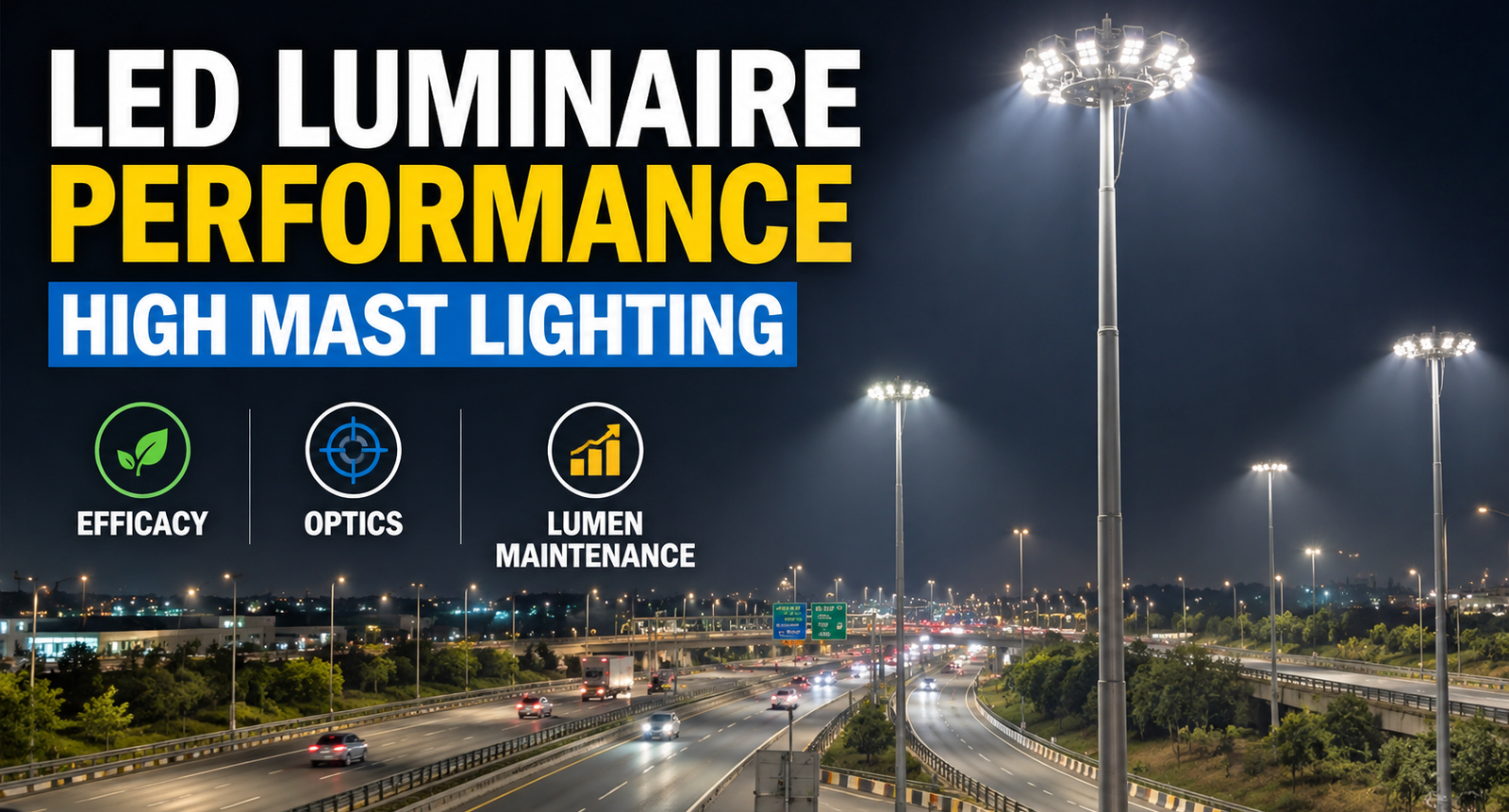
At 30-40 metres of mounting height, luminaire performance data isn’t a marketing spec sheet exercise — it’s the difference between meeting the design lux level at grade and quietly under-lighting a highway interchange for the next decade. Because high mast luminaires are so difficult to access for inspection or early replacement, procurement decisions here carry consequences that are unusually delayed and unusually expensive to correct once discovered high mast LED luminaire selection.
This section covers system-level efficacy, optical lens material, and the TM-21 lumen maintenance projection that determines when a high mast luminaire actually needs replacing, along with the datasheet traps that make performance comparison between vendors harder than it should be.
Luminaire selection is unusual among high mast components in that the underlying LED technology genuinely does improve year over year, which creates a real temptation to chase the latest headline efficacy number without verifying that number was measured the same way as competing quotes. A rigorous, apples-to-apples comparison methodology — grounded in independently verified system-level data rather than manufacturer marketing figures — matters more in this fast-moving product category than in almost any other component covered in this article series.
System-Level Luminous Efficacy Including Driver Losses
The efficacy figure that matters for procurement isn’t the LED chip’s raw lm/W rating — it’s system-level efficacy, measured at the luminaire output after driver losses, optical losses, and thermal derating are all accounted for. Quality high mast LED luminaires today achieve system-level efficacy above 130-150 lm/W, though headline chip-level numbers from datasheets often run 10-20% higher than what actually leaves the fixture, since chip-level ratings are typically measured under laboratory conditions that don’t reflect installed thermal and electrical realities.
Procurement specifications should require LM-79 photometric test reports (independent lab-verified system output, not chip-level claims) rather than accepting manufacturer efficacy claims at face value. LM-79 testing measures the complete luminaire — driver, optics, thermal management, and LED chips together — as an integrated system, which is the only way to get a number that actually predicts field performance.
A related and often overlook comparison point: two luminaires with identical LM-79 system efficacy can still differ meaningfully in how that light is distributed — a fixture with excellent raw efficacy but poor optical control can still under-deliver on design lux at grade level if too much of its output is waste as glare or spill light rather than useful illumination on the target surface, which is why efficacy alone is never a sufficient specification without an accompanying photometric distribution check.
Optical Lens Material: UV-Stabilized PMMA vs. Tempered Glass
Secondary optics on high mast LED luminaires are specifie in either UV-stabilize polymethyl methacrylate (PMMA) or temper glass. PMMA offers excellent optical clarity, lighter weight, and good UV resistance when properly stabilized — but is more susceptible to long-term yellowing and surface abrasion in dusty, high-UV Indian climates without adequate stabilizer packages, and stabilizer quality varies considerably between manufacturers even when both claim ‘UV-stabilized’ on their datasheets high mast LED luminaire selection.
Tempered glass costs more and adds weight (a real consideration for headframe EPA and wind load, per Cluster 5) but offers superior long-term optical clarity retention and scratch resistance, often preferred for premium highway and stadium-grade fixtures with 10+ year clarity-retention requirements where even a modest reduction in light transmission over time has measurable operational consequences.
The practical procurement question isn’t simply ‘PMMA or glass’ in the abstract — it’s matching lens material to the specific dust and UV exposure profile of the installation site and to the headframe’s available weight budget, since a highway mast in a high-dust, high-UV region with generous structural capacity might reasonably justify glass despite the weight penalty, while a coastal installation with different degradation drivers and tighter EPA constraints might favour a high-quality stabilized PMMA instead.
TM-21 Lumen Maintenance: L70 Life at Elevated Ambient Temperature
TM-21 (IES TM-21-11) is the industry-standard method for projecting long-term lumen depreciation from LM-80 chip test data, expressed as an L70 rating — the operating hours at which output has depreciated to 70% of initial lumens. Quality high mast LED products target L70 ratings of 50,000-100,000 hours, but critically, this figure must state at a realistic ambient temperature — 45°C is a reasonable Indian summer ambient-plus-thermal-rise assumption for an outdoor fixture, not the 25°C lab-ideal condition some datasheets quote.
A luminaire rated L70 at 100,000 hours at 25°C can perform meaningfully worse at 45°C ambient — always request the TM-21 projection at the elevated temperature relevant to actual deployment conditions, not the most favourable number on the datasheet, since LED lumen depreciation accelerates non-linearly with junction temperature and the gap between a 25°C-rated and 45°C-rated projection for the same physical product can be substantial.
Beyond the headline L70 hours figure, the underlying LM-80 test duration and the number of sample units tested feeds directly into how much confidence the TM-21 extrapolation actually deserves — a projection extrapolated from a longer underlying LM-80 dataset (ideally 6,000+ hours of actual measured data) with multiple sample units carries materially more statistical confidence than one extrapolated aggressively from a shorter test period, even if both quote the same final L70 number on paper.
Thermal Management and Driver Placement Impact on Real-World Performance
Lumen maintenance projections are only as good as the thermal environment the luminaire actually experiences in service, which makes heat sink design and driver placement just as important to long-term performance as the LED chip specification itself. A luminaire with excellent LM-80 chip data but an undersized or poorly designed heat sink will run its LEDs at a higher junction temperature than the datasheet projection assumed, silently degrading real-world lumen maintenance below the quoted TM-21 figure regardless of how rigorous that figure’s underlying testing was.
Driver placement — whether integrated directly against the LED heat sink or mount remotely with a separate thermal path — affects both driver life and, indirectly, LED performance, since a driver forced to operate at elevate ambient temperature near the LED array typically has a shorter service life than one with better thermal isolation, even though the two failure modes (driver failure versus LED lumen depreciation) are often evaluate separately in procurement rather than as an interconnect thermal system.
Site-specific thermal validation — ideally a thermal imaging check on installed fixtures during peak summer ambient conditions, comparing measured case or heat sink temperature against the manufacturer’s rated maximum — provides a real-world sanity check on whether the laboratory-derived lumen maintenance projections are likely to hold up in the specific climate and mounting configuration actually deployed, rather than trusting the datasheet figure as automatically applicable to every installation context high mast LED luminaire selection.
Comparative Technical Data Table
| Metric | Datasheet Trap | What to Actually Request |
| Efficacy (lm/W) | Chip-level, no driver loss | LM-79 system-level test report |
| Lumen Maintenance | L70 at 25°C lab condition | TM-21 projection at 45°C ambient |
| Lens Material | Generic ‘UV resistant’ claim | Stabilizer grade / glass transmittance spec |
| Optical Efficiency | Not stated | Fixture efficiency % (lumens out / lumens in) |
Practical Field Best Practices
- Require independent LM-79 test reports for every luminaire model tendered, not manufacturer self-certification alone.
- Specify TM-21 lumen maintenance projections at 45°C ambient, matching realistic Indian deployment conditions.
- Choose lens material (PMMA vs. tempered glass) based on site dust/UV exposure and headframe weight budget together.
- Cross-check quoted system efficacy against optical efficiency and driver efficiency separately — a high chip efficacy can still yield poor system output.
- Request the underlying LM-80 test duration and sample size behind any TM-21 projection, not just the final L70 number.
- Verify photometric distribution alongside raw efficacy — high output that isn’t well-direct still under-delivers design lux.
Summary Checklist
- System-level efficacy verified via LM-79, not chip datasheet figures.
- Lens material selected for long-term UV/dust exposure, not lowest initial cost.
- TM-21 L70 lumen maintenance requested at 45°C ambient, not lab-ideal temperature.
- Fixture weight from lens/optic choice checked against headframe EPA and wind load budget.
- LM-80 underlying test duration and sample size reviewed for statistical confidence.
- Photometric distribution data reviewed alongside efficacy to confirm design lux delivery.