A high mast luminaire ring that hangs on wire rope tension alone, indefinitely, is a maintenance liability — ropes creep, winches drift, and nobody wants years of dead load sitting on a cable that was design for lifting cycles, not permanent suspension. This section covers the mechanical lock-in device that relieves that tension, the indicators that confirm a secure latch from ground level, and how the latching hardware survives years of exposure while being cycle only rarely.
Understanding this system matters because it’s the layer of the design most likely to be taken for granted once installed — a well-functioning latch mechanism is invisible in daily operation right up until the day it isn’t high mast luminaire ring latching system.
There’s a useful analogy here to landing gear on an aircraft: the mechanism only becomes the center of attention during the brief moments of transition — raising or lowering — while spending the overwhelming majority of its operational life in a static, locked state that’s easy to overlook precisely because it’s working correctly. Specification and maintenance attention calibrated to this reality, rather than to how often the mechanism visibly operates, is what keeps a latching system reliable across a multi-decade service life.
Mechanical Lock-In Devices: Relieving Tension on the Wire Rope
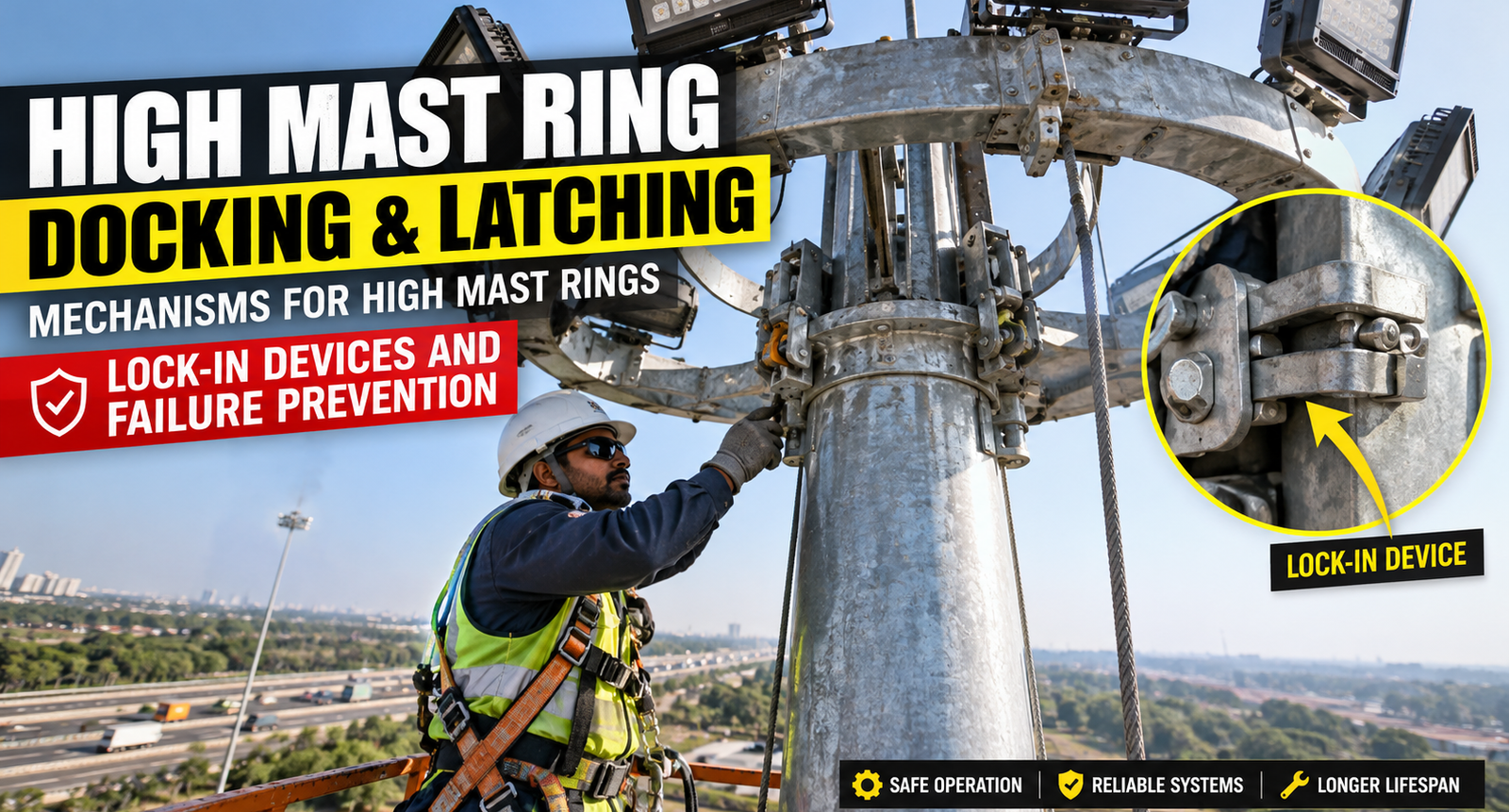
A properly designed high mast system includes a mechanical latching or lock-in device at the headframe that physically engages once the ring reaches its fully-raised position — commonly spring-loaded latch pins or a cam-lock mechanism that grips a mating feature on the ring frame — so that once docked, the ring’s weight transfers to this rigid mechanical connection rather than remaining suspended on wire rope tension.
This matters because wire rope under permanent static load (rather than intermittent lifting load) is subject to creep and, more importantly, any single-point rope failure while the ring is ‘parked’ on rope tension alone would mean an uncontrolled drop — the lock-in device removes that single point of failure from the equation during normal operation, which is the vast majority of the structure’s service life given that raising and lowering only happens during schedule maintenance.
The design principle at work here echoes the redundancy philosophy discuss for winch braking (Cluster 6): rather than trusting one component (the rope and winch) to hold load indefinitely and reliably, the system is designed so that the component best suite to sustained static load (a rigid mechanical latch) does that job, while the component best suite to control motion (rope and winch) is only load during the brief periods it’s actually need for that purpose.
Ground-Level Confirmation: Visual and Electronic Latch Indicators
Because the latch mechanism sits 30-40m overhead, operators need a positive confirmation signal without climbing or using binoculars for every operation. Visual indicators — a paint marker band on the wire rope that aligns with a reference point on the pole base when the ring is correctly dock — are the low-cost baseline, giving a simple go/no-go visual check any field technician can perform.
More advanced systems use an electronic limit switch or proximity sensor at the latch point, wired down to a ground-level indicator panel or integrated into the feeder pillar controls (see Cluster 14), giving a definitive engaged/not-engaged signal rather than relying on rope-position inference alone. This distinction matters in practice: a rope marker band confirms the rope has traveled the expected distance, but it doesn’t directly confirm the latch mechanism itself has actually engaged — a jammed or partially engaged latch with the rope at the ‘correct’ visual position is exactly the failure mode a purely visual system can miss.
For larger installations — stadium lighting masts, major highway interchanges — the incremental cost of electronic latch confirmation, tied into a centralized monitoring system, is generally justified by the consequence of an undetected latch failure at that scale, whereas simpler single-mast street lighting installations more commonly rely on the visual marker band approach as adequate for the risk profile involved.
Protecting Latching Pins from Freezing, Dirt, and Rust
Latching pins and their engagement sockets are typically manufacture from stainless steel or hard-chrome-plate steel specifically to resist the corrosion that would otherwise seize a mechanism operate infrequently — some sites only cycle the ring once or twice a year for maintenance, so any latch that relies on staying rust-free through disuse is a design risk rather than a maintenance inconvenience.
Good practice adds a light film of appropriate marine-grade grease on pin surfaces (not on the wire rope, which needs a different lubricant class suited to its own wear mechanism) and rubber or PVC boot covers over the mechanism where feasible, reducing direct rain and dust exposure without interfering with latch action.
In regions with genuine winter freezing conditions — parts of northern India during peak winter — accumulate moisture in a latch mechanism can freeze and prevent engagement or release entirely at exactly the time of year maintenance access is already more difficult; specifying latch geometry that sheds water rather than pooling it, alongside appropriate low-temperature grease formulation, addresses a failure mode that’s easy to overlook when a system is design and test primarily in warmer conditions.
Emergency Release Procedures for a Jammed Latch
Every latch mechanism, however well maintained, needs a defined emergency release procedure for the scenario where it fails to disengage on command during a scheduled lowering operation — leaving a technician needing to free a jammed latch without resorting to force that could damage the mechanism further or, worse, release unpredictably under load. This procedure should document in the site’s operations and maintenance manual, not left to improvisation by whichever crew happens to encounter the jam first.
A well-design latch anticipates this scenario in its own geometry — for instance, incorporating an accessible manual release lever reachable from the ring’s normal maintenance access position, rather than requiring the latch’s internal spring mechanism to defeate through brute force from an awkward angle. Systems lacking this kind of design-in manual override tend to generate ad-hoc field workarounds that can compromise the mechanism’s future reliability even after the immediate jam is clear.
Training maintenance crews specifically on the jammed-latch emergency procedure — ideally through a hands-on demonstration during commissioning rather than only a written manual reference — closes the gap between a theoretically sound emergency procedure and one that a stressed technician can actually execute correctly 30 metres up a pole on an unfamiliar site high mast luminaire ring latching system.
Practical Field Best Practices
- Never accept a design where the ring remains permanently suspended on wire rope tension alone at the docked position.
- Specify electronic latch confirmation for any site where ground crew can’t easily visually verify the rope marker band.
- Use stainless or hard-chrome latching pins, not plain mild steel, for infrequently-cycled mechanisms.
- Include latch mechanism function checks in the annual maintenance cycle, not just wire rope inspection.
- Specify latch geometry that sheds water rather than pooling it, particularly for cold-climate installations.
- Justify electronic vs. visual latch confirmation by installation scale and failure consequence, not default habit.
Summary Checklist
- Mechanical lock-in device confirmed to relieve wire rope tension at full-raise position.
- Ground-level latch confirmation available (visual marker or electronic indicator).
- Latching pins specified in corrosion-resistant material for infrequent-cycle reliability.
- Latch mechanism included in the routine annual maintenance inspection scope.
- Visual marker band verified to actually confirm latch engagement, not just rope travel distance.
- Low-temperature grease and water-shedding geometry considered for cold-climate sites high mast luminaire ring latching system.