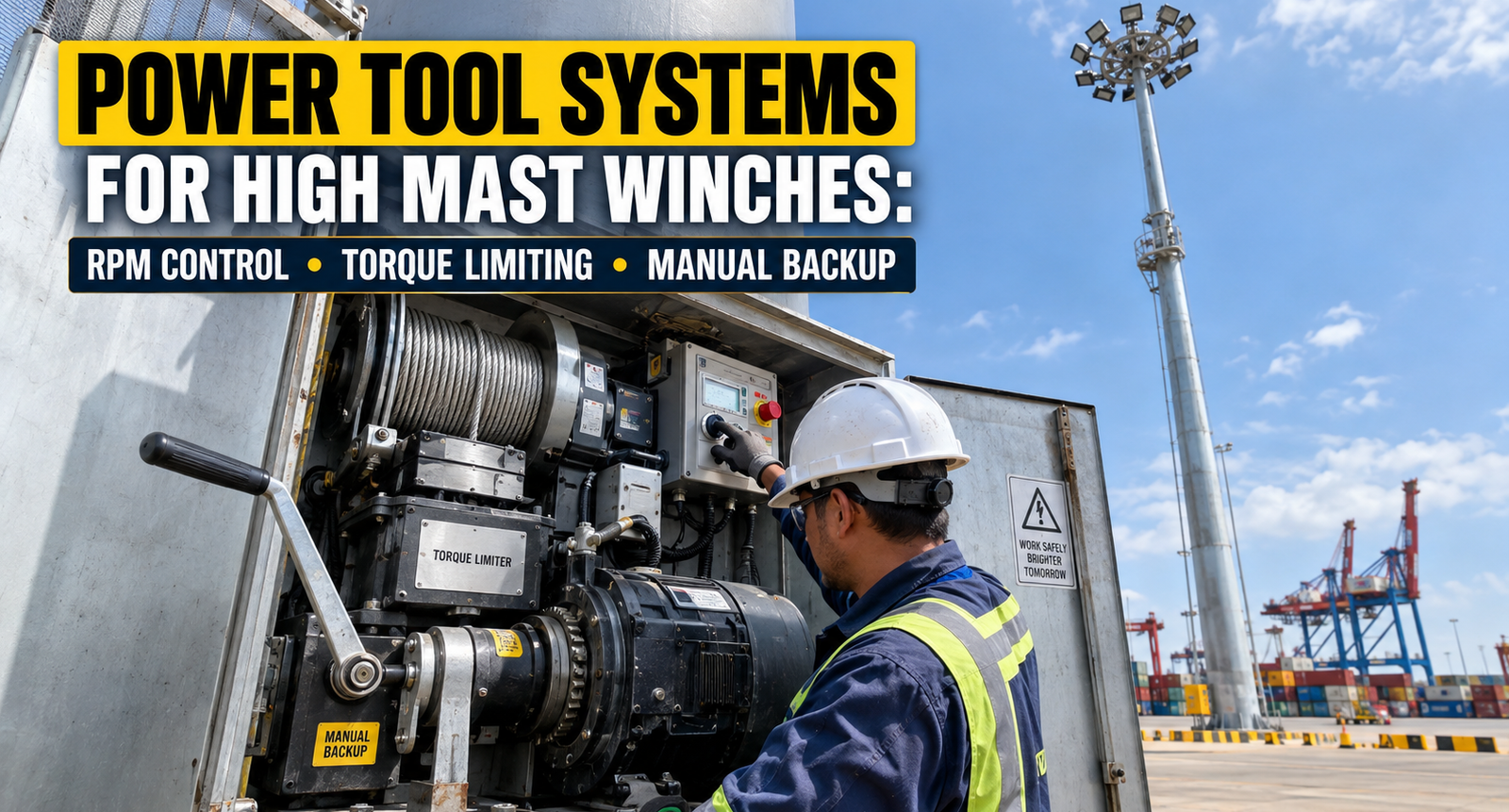
Raising and lowering a high mast luminaire ring by hand crank alone is slow and physically demanding at the load levels involved — which is why most modern systems pair the winch with a portable electric power tool. But a power tool that’s faster and more convenient than a hand crank introduces its own risk: it can apply far more torque, far more quickly, than a human arm ever could, and that capability needs to be deliberately constrained rather than left to operator judgment alone.
This section covers motor RPM design, the torque-limiting mechanism that prevents cable damage, and why manual override capability remains mandatory regardless of how reliable the power tool is.
It’s a useful discipline, when evaluating any high mast power tool system, to think of the tool not as a convenience accessory but as a component that sits directly in the load path during every raising and lowering operation — its torque-limiting behaviour, its RPM control, and its manual backup interface are all, in effect, safety features first and productivity features second, even though they’re often marketed and evaluated primarily on the basis of speed and operator convenience.
Fixed vs. Adjustable RPM Motor Design
The electric power tool used to drive a high mast winch is typically a portable drill-type or dedicated hand-held motor unit with a fixed, relatively low RPM output geared specifically to the winch input shaft — high RPM is deliberately avoided because winch drum rotation speed must stay controlled enough for the operator to visually track ring position and react to any binding or obstruction during travel.
Some higher-end systems offer two-speed or variable RPM control — a faster speed for the bulk of the travel distance and a slower, more controlled speed as the ring approaches its final docked or fully-lowered position, reducing impact loading at end-of-travel and giving the operator more precise control exactly when precision matters most.
The RPM choice also interacts with rope life: faster winding speeds increase the rate at which rope experiences bend cycles over the pulley and drum, and rapid engagement/disengagement at speed introduces more shock loading into the rope and winch train than a slower, smoother operation — a consideration that favours moderate fixed speeds over maximizing operational speed for its own sake.
Torque Limiters and Slip Clutches: Preventing Over-Tensioning
A mechanical slip clutch or torque limiter is integrat between the power tool output and the winch input specifically to cap the maximum torque transmit — this prevents the power tool from continuing to drive the winch (and therefore over-tensioning the wire rope) if the ring reaches a hard stop, jams, or if an operator fails to release the trigger at the top or bottom limit.
Torque limiter setting is calibrate against the winch and rope’s safe working load, not the motor’s maximum output — the clutch should slip well before rope tension approaches the rope’s minimum breaking load safety margin, giving a genuine mechanical safety margin rather than merely a theoretical one that assumes perfect operator attentiveness.
This is a component that requires periodic verification rather than a one-time factory setting assumption: slip clutches can drift in their engagement torque over time and with wear, and a clutch that’s drift to a higher-than-specified slip torque silently removes a safety margin that nobody notices until an over-tensioning event actually occurs. Including torque clutch verification in periodic maintenance — even a simple functional test against a known load — closes this gap.
Manual Handle Conversion During Power Outages
Every high mast winch system retains a manual crank handle interface as a mandatory backup, allowing the power tool to quickly disconnect and a hand crank fit directly to the same winch input shaft — critical during grid blackouts or if the power tool itself fails, since street lighting maintenance frequently coincides with exactly the kind of local power disruption that would strand a purely electric-dependent system.
This dual-interface design (power tool socket and manual handle square/hex drive on the same shaft) is a basic reliability requirement across virtually every high mast lowering system specification, not an optional extra — a system without this fallback effectively becomes unmaintainable during the exact conditions (storm damage, grid failure) when urgent luminaire access might be most needed.
Manual operation also serves as a useful diagnostic tool independent of any actual power outage: an experienced maintenance technician can often feel through the hand crank whether the winch, gearbox, or rope is developing unusual resistance or binding well before it becomes severe enough to trip a torque limiter or stall a power tool, making periodic manual-mode operation a worthwhile maintenance practice even when power is available.
Operator Safety Interlocks and Ergonomic Considerations
Beyond the mechanical torque-limiting function, well-designed power tool systems for high mast winches typically include a dead-man’s switch requiring continuous operator pressure to maintain drive — releasing the trigger for any reason immediately stops power to the winch input, adding a layer of operator-controlled safety that complements the automatic mechanical torque limiting rather than duplicating it.
Ergonomics matter more than they might initially appear for a task that seems purely mechanical: a power tool that’s excessively heavy, poorly balanced, or requires an awkward operating posture increases the likelihood of an operator error during a multi-minute raising or lowering operation, particularly toward the end of a long maintenance round covering many masts in a single shift. Vendors offering a shoulder harness or support stand accessory for the power tool reduce this fatigue-related risk meaningfully on larger maintenance contracts.
Cable management for the power tool’s own electrical supply — typically run from a portable generator or the feeder pillar connection — deserves the same attention as the winch’s internal wiring, since a trailing cable that snags or drags across the ground during operation is both a trip hazard for the operator and a potential source of electrical damage that undermines an otherwise well-engineered system.
Practical Field Best Practices
- Confirm torque limiter setting is document and calibrate against rope safe working load, not left at factory default blindly.
- Prefer two-speed power tools for large sites with many masts, reducing operator fatigue and end-of-travel impact.
- Keep a manual crank handle in every maintenance vehicle — don’t rely solely on the power tool being available.
- Test manual handle conversion during routine maintenance, not only during an actual outage.
- Include periodic functional verification of torque clutch slip point in the maintenance schedule.
- Use manual-mode operation occasionally as a diagnostic feel-check for developing mechanical resistance.
Summary Checklist
- Power tool RPM matched to safe visual-tracking speed for ring travel.
- Torque limiter/slip clutch calibrated to winch and rope safe working load.
- Manual crank handle interface confirmed functional on the same input shaft.
- Two-speed control considered for large multi-mast maintenance contracts.
- Torque clutch slip point verified periodically, not assumed stable indefinitely.
- Manual-mode diagnostic checks incorporated into routine maintenance practice.