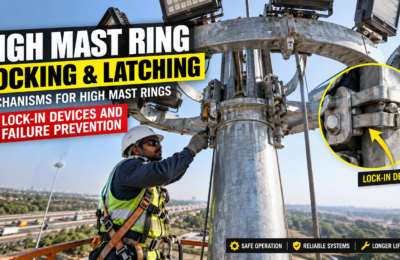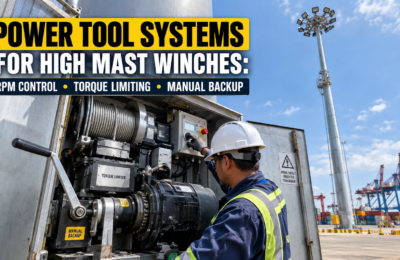

The headframe assembly at the top of a high mast pole is the hardest-working, least-inspected component in the entire system. Its pulleys carry the full ring load through thousands of raise-lower cycles, exposed to UV, monsoon rain, and — if the design is sloppy — nesting birds, all while sitting 30-40m above the nearest ground-level technician.
This section covers pulley material selection, bearing design, and how a well-engineered headframe cover keeps the mechanism dry and functional for decades, along with the practical maintenance realities of a component that’s expensive and disruptive to access.
The headframe is, in a sense, where every other design decision covered elsewhere in this article series converges physically — the wire rope, the winch’s pulling capacity, the ring’s dead weight, and the wind load’s effect on EPA all meet at this one assembly. A weak link anywhere in the headframe undermines the value of getting every other component right, which is why its material and bearing specification deserves the same rigor typically reserved for the structural pole itself, even though it’s a comparatively small and inexpensive assembly by weight.
Pulley Wheel Material: Cast Aluminum Alloy vs. Heavy-Duty Nylon
Headframe pulley wheels are specified in either non-corrosive cast aluminum alloy or heavy-duty engineering nylon (often glass-filled nylon 6 or acetal/Delrin for higher load applications) — never mild steel, which would corrode rapidly at height with minimal maintenance access and risk seizing the entire lowering mechanism.
Aluminum alloy pulleys offer higher load capacity and dimensional stability across temperature extremes, favoured on heavier headframes with multiple luminaires where sustained load and occasional shock loading (a rope catching momentarily during travel) demand more margin. Nylon and engineering polymer pulleys offer quieter operation, zero galvanic corrosion risk against the stainless wire rope, and lower weight — often preferred on lighter, single-ring assemblies where load capacity margins are less critical and reducing headframe EPA (see Cluster 5) is a design priority.
A subtlety worth noting: aluminum pulleys running against stainless steel wire rope create a galvanic couple in the presence of moisture, which — while generally slow-acting given aluminum’s naturally protective oxide layer — is a real long-term consideration in consistently humid or coastal environments, whereas nylon pulleys eliminate this galvanic pairing entirely by virtue of being non-metallic.
Sealed-for-Life Bearings to Prevent High-Altitude Seizing
Pulley bearings are specified as sealed-for-life, self-lubricating types — typically sealed ball bearings with a synthetic grease pack rated for the temperature range and moisture exposure at height, since re-greasing a headframe bearing 30-40m up is operationally impractical on any routine basis and would require exactly the kind of climbing access that lowering-ring systems exist to avoid.
Seizing risk comes primarily from moisture ingress displacing lubricant and from dust or grit contamination — both of which point back to the quality of the bearing seal design, not just the bearing’s load rating. A bearing with an excellent load rating but a poor-quality lip seal will still fail prematurely in a high mast application, because the failure mode here is almost never overload — it’s environmental contamination degrading the lubricant over years of exposure.
Bearing selection should also account for the very low rotational speed and intermittent duty cycle typical of a pulley wheel (a handful of full raise-lower cycles per year in many installations) — this is a fundamentally different load profile from a continuously rotating industrial bearing, and grease formulations optimized for continuous high-speed operation aren’t necessarily the best choice for a component that sits static for months and then needs to turn freely on demand.
Headframe Cover Design: Keeping Out Rainwater and Nesting Birds
A properly engineered headframe cover uses a weather-hood geometry — overlapping louvers or a sloped canopy — that sheds rainwater away from the pulley block while still allowing the wire rope to pass through a close-tolerance slot, rather than an open gap that both admits water and invites birds to nest against the warm, sheltered pulley housing.
Bird ingress is a genuine operational problem in India — nesting material can jam pulley rotation or, worse, create an electrical fire risk near luminaire wiring where nests accumulate close to power connections — so mesh screening across any ventilation gaps in the cover is standard good practice beyond the base specification, and one of the more cost-effective retrofits available for older headframes that were designed before this risk was well understood.
Cover design also has to reconcile two somewhat competing goals: keeping the enclosure sealed enough to exclude water and pests, while still allowing enough ventilation to prevent condensation build-up inside the headframe housing itself, since a fully sealed enclosure at height can actually trap humid air and create its own internal condensation problem through daily thermal cycling — the louvered, rather than fully sealed, cover design exists specifically to balance this trade-off.
Headframe Access and Maintenance-Friendly Design
Even the best-designed headframe eventually needs hands-on attention — bearing replacement, pulley inspection, or cover repair — and how easily that access can achieve without a full climbing or man-basket operation materially affects the practical maintenance frequency a site actually receives versus what the maintenance manual recommends. Headframes designed with the lowering-ring system itself doubling as an access platform (bringing the pulley housing down to the ring’s travel range rather than requiring separate access to a fixed point at the very top) meaningfully reduce this friction.
Quick-release fasteners on cover panels, rather than fully bolted covers requiring a full tool kit at height, reduce both the time and the risk associated with routine inspection access. Small design choices at this level compound over a 25-30 year service life into a meaningful difference in how consistently a site actually receives its specifie maintenance versus how often that maintenance gets deferred because access is inconvenient.
Specification writers benefit from walking through the actual physical sequence a maintenance technician would follow to inspect or service the headframe — not just confirming the design meets a materials and performance specification on paper — since a technically compliant headframe that’s genuinely difficult to service in practice tends to receive less maintenance over its life than one designed with technician access as an explicit design criterion from the outset.
Practical Field Best Practices
- Specify aluminum alloy pulleys for multi-luminaire heavy headframes, nylon for lighter single-ring designs.
- Confirm bearing seals are rate for the site’s monsoon/humidity exposure, not just a generic IP rating.
- Add mesh screening to any headframe cover ventilation gap to block bird nesting, beyond minimum spec.
- Inspect headframe cover integrity annually — a cracked or displaced cover defeats the entire weatherproofing design.
- Select bearing grease formulation for low-speed, intermittent duty cycles, not generic industrial continuous-duty grease.
- Retrofit mesh screening onto older headframes that predate current bird-ingress design awareness.
Summary Checklist
- Pulley material (aluminum alloy or nylon) matched to headframe load profile.
- Bearings confirmed sealed-for-life and self-lubricating, rated for site humidity.
- Headframe cover sheds water via sloped/louvered geometry, not open gaps.
- Bird-nesting risk mitigated with mesh screening on ventilation openings.
- Galvanic coupling risk between aluminum pulleys and stainless rope considered for coastal sites.
- Cover design balances weatherproofing against internal condensation ventilation needs.