
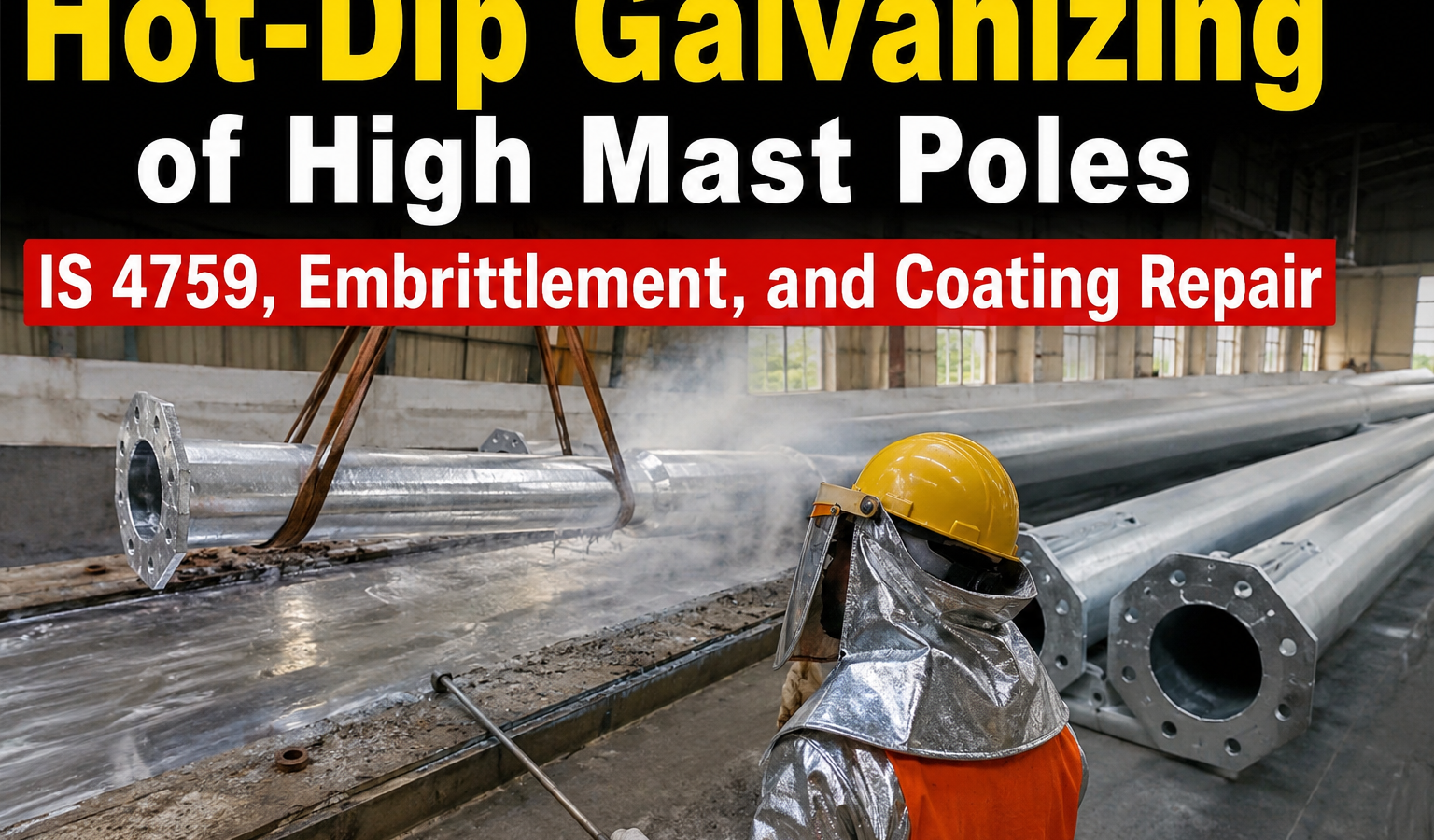
Zinc is the only line of defense a high mast pole has against 25+ years of monsoon exposure, and the galvanizing bath is where that defense is either built correctly or compromise permanently. Everything upstream — steel chemistry, plate thickness, surface preparation — converges at the kettle, and everything downstream — service life, maintenance cost, structural integrity at the base flange — depends on what happens during those few minutes of immersion Hot-Dip Galvanizing of High Mast Poles.
This section covers the governing standards for coating thickness, the metallurgical risk of hydrogen embrittlement during pickling, and what happens procedurally when a section fails coating-thickness inspection, along with the practical realities of galvanizing structures long enough to challenge most kettle dimensions in the country.
Galvanizing quality is unusual among the checks covered in this article series in that it’s simultaneously easy to measure (a magnetic thickness gauge gives an immediate, objective number) and easy to under-specify (many tenders quote a single flat coating thickness figure without reference to the base-metal thickness class that actually governs what’s achievable and appropriate). Understanding both the measurement and the underlying metallurgy is what separates a specification that merely looks rigorous from one that actually protects the structure for its intended design life.
Governing Standards: IS 4759 and BS EN ISO 1461
Hot-dip galvanizing of structural steel high mast components in India is specified against IS 4759 (or the international equivalent BS EN ISO 1461 for export work). Both standards define minimum average coating thickness by base-material thickness class — for steel above 6mm, a minimum local coating thickness of around 85 microns and average of 100+ microns is typical, dropping to lower thresholds for thinner tip sections where less zinc naturally deposits.
Compliance isn’t just about achieving the thickness number — the standard also governs coating uniformity, adherence (verified through a defined bend or impact test without flaking), and surface finish (free of ash inclusions, bare spots, and excessive dross runs that both look poor and represent genuinely weaker localized protection).
A detail often missed in tender specifications: coating thickness requirements scale with base steel thickness precisely because thicker steel retains heat longer in the kettle, allowing more iron-zinc alloy layer growth and therefore a naturally thicker coating. Specifying a single flat coating thickness number across a pole whose wall thickness varies from 4mm at the tip to 12mm at the base ignores this metallurgical reality and can lead to unnecessary rejection of perfectly adequate thin-section coatings, or under-specification of the thick base section.
Preventing Warping and Hydrogen Embrittlement During Pickling and Dipping
Two distinct failure modes threaten a pole during galvanizing: thermal distortion (warping) from uneven heating and cooling in the roughly 450°C zinc kettle, and hydrogen embrittlement introduced during acid pickling before the section ever reaches the kettle.
Warping control starts before the kettle — sections are pre-heated and lower into the bath at a control angle and speed, entering and withdrawing along the taper axis to equalize thermal gradients across the long, thin-wall shaft. Fabricators with dedicated high mast kettles (often 12-15m single-dip length) avoid the double-dipping that multiplies distortion risk on long sections, since progressive dipping — immersing part of the section, then advancing further — creates uneven thermal history along the length and is a common source of visible bow in finished poles.
Hydrogen embrittlement is a pickling-stage risk, not a kettle-stage one: acid cleaning (typically hydrochloric acid pickling to remove mill scale) can drive atomic hydrogen into high-strength steel, embrittling it and creating a delayed-fracture risk that may not manifest until the structure is already in service and under sustained load. Mitigation includes limiting pickling time and acid concentration, using inhibited acid baths that reduce hydrogen pickup, and — for higher strength grades — considering mechanical (abrasive blast) surface preparation instead of acid pickling where the steel’s strength class makes it particularly susceptible.
Kettle Length Constraints for Long Single-Piece Sections
A 30-40m high mast is never galvanize as a single piece — it’s fabricate in multiple taper sections join slip-joints specifically because no commercial galvanizing kettle in most regions exceeds roughly 15m in single-dip length. Engineers specifying pole section lengths should confirm the fabricator’s actual kettle dimensions before finalizing section breakup, since a section designed 1-2 metres longer than the available kettle forces double-dipping and the distortion risk that comes with it Hot-Dip Galvanizing of High Mast Poles.
Stripping and Re-Inspection Protocol for Under-Thickness Coating
When a section fails minimum coating thickness on magnetic gauge inspection, the standard remedy is not spot-repair paint — it’s full stripping and re-dipping. The section is return to a caustic or acid stripping bath to remove the deficient zinc layer entirely, re-clean (degreased, pickled, fluxed), and re-dipped from scratch as though starting the process fresh.
Only minor localize damage (small holidays from handling after the original dip, such as a chain mark or a scrape from a forklift) is repaired in-place, typically with zinc-rich paint or metallizing per ASTM A780 / IS 4759 repair provisions — and even then, repair area is cap as a small percentage of total surface area, often around 0.5-1% per repair location and limit in total number of repairs per section, before the section must re-dip instead of patched.
This distinction matters commercially as much as technically: a fabricator under schedule pressure has an incentive to over-use the cold-repair allowance rather than absorb the cost and time of re-dipping. Inspection protocols should measure and log total repaired area per section against the specification’s cap, not simply confirm that individual repair patches meet the local thickness test.
Post-Galvanizing Handling and Transport Damage Prevention
A section that leaves the kettle with fully compliant coating thickness can still arrive at site with damaged galvanizing if handling and transport protocols aren’t specified alongside the galvanizing standard itself. Chain slings dragged across a freshly coated surface, sections stacked directly on top of each other without dunnage, and improper crane rigging points are all common sources of coating damage that occur well after the quality inspection that certified the section as compliant.
Good practice specifies pad or webbing slings rather than chain for lifting galvanize sections, dedicate cradle supports during transport that avoid point contact between sections, and designat lifting points mark on the section itself so rigging crews aren’t left to select their own attachment locations under time pressure. These measures cost very little relative to the galvanizing process itself but protect the investment made in achieving compliant coating in the first place.
Receiving inspection at site — a quick visual and thickness-gauge check upon delivery, before the section is erect — closes the loop catching any transport damage while it’s still cheap and straightforward to repair or escalate for re-dipping, rather than discovering a damage coating only after the section is already install atop a foundation 30 metres in the air.
Comparative Technical Data Table
| Base Steel Thickness | Min. Local Coating (µm) | Min. Average Coating (µm) |
| ≥6mm | 85 | 100 |
| 3-6mm | 70 | 85 |
| 1.5-3mm | 55 | 70 |
| <1.5mm (sheet) | 45 | 55 |
Practical Field Best Practices
- Request the galvanizer’s kettle dimensions before ordering long single-piece sections — double-dipping increases distortion risk Hot-Dip Galvanizing of High Mast Poles.
- For high-strength steel grades, discuss pickling-time limits or mechanical prep as embrittlement mitigation with the galvanizer.
- Use a calibrated magnetic thickness gauge at multiple points per section, not a single reading, before accepting.
- Cap cold-repair area strictly per IS 4759 provisions; anything beyond that threshold goes back in the kettle.
- Verify coating thickness requirements are applie per actual local wall thickness, not a single flat number for the whole pole.
- Log cumulative repaired area per section across the full inspection history, not per individual patch.
Summary Checklist
- Coating thickness verified against IS 4759 / BS EN ISO 1461 by base-metal thickness class.
- Kettle dip sequence and angle controlled to limit thermal warping on long sections.
- Pickling parameters reviewed to control hydrogen embrittlement risk.
- Under-thickness sections are strip and re-dipped, not merely touch-up paint.
- Section lengths confirm compatible with the specific kettle being use before fabrication.
- Total cold-repair area tracked and capped per specification across the section’s full surface.