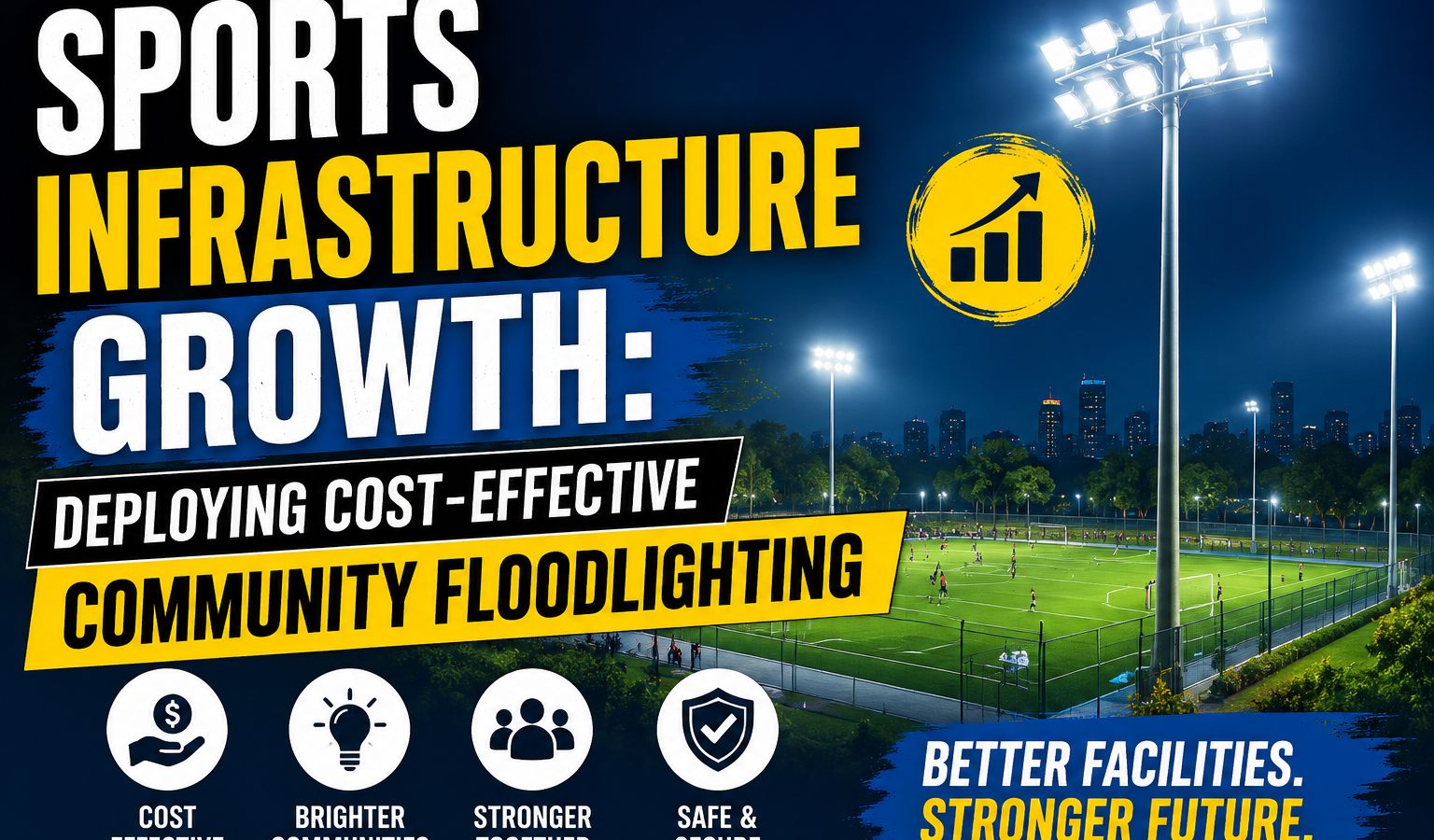
Community and school-level sports infrastructure across Punjab, Gujarat, Tamil Nadu, and Telangana is expanding steadily as regional recreation and youth sports participation grows, but the budget realities facing school boards, private clubs, and municipal recreation departments are considerably different from the broadcast-grade stadium projects discussed elsewhere in this series. Sports Stadium Floodlight Contractors Punjab, For these buyers, the central question isn’t how to meet international broadcast standards — it’s how to deliver genuinely usable, safe floodlighting within a budget that has to stretch across many competing recreational infrastructure priorities.
Configuring Multi-Sport Lighting Layouts to Fit Various Fields on a Budget
Sports Stadium Floodlight Contractors Punjab projects serving school and community facilities frequently need to light a single field that hosts multiple sports at different times — football practice in the evening, cricket matches on weekends, and general community recreational use in between. Rather than designing separately optimized lighting for each specific sport, which would multiply cost considerably, cost-conscious community projects typically specify a general-purpose layout calibrated to the most lighting-demanding regular use case the field actually sees, accepting a reasonable compromise for less frequent secondary uses rather than over-engineering the installation for every possible activity the field might occasionally host.
Lowering Installation Costs With Pre-Built Foundation Templates
Stadium Floodlighting Contractors Rajkot and comparable community-facility contractors have found that standardizing on a limited set of common pole heights and pre-engineered foundation designs, rather than custom-engineering every single community project from scratch, meaningfully reduces both design time and installation cost. For a budget-constrain school board or recreation department, this standardization can represent a genuinely significant portion of total project savings, provided the site’s actual wind load and soil conditions fall within the range the standard template was design to handle — a basic site assessment should still confirm this fit before committing to the standard template approach.
Setting Up Routine Preventive Upkeep on Community Budgets
Stadium Light Pole Maintenance Tamil Nadu work for community and school facilities has to account for the reality that these organizations rarely have dedicated facility maintenance staff comparable to a professional sports venue. A simple, low-complexity annual maintenance routine — luminaire cleaning, structural bolt-torque verification, and basic control panel inspection, scheduled ahead of the facility’s peak seasonal usage — helps these organizations avoid the kind of deferred-maintenance deterioration that eventually forces a far more expensive full system overhaul, without requiring the kind of dedicated in-house maintenance capacity a professional venue would maintain.
Multi-Sport Facility Growth in Telangana
Stadium Floodlighting Systems Telangana community and educational installations reflect the broader pattern of growing recreational sports infrastructure investment across the state, often serving genuinely mixed-use campuses that combine school athletics, community recreation, and occasional evening events all on the same field. Facilities planning new floodlighting in this context benefit from consulting with local sports coordinators and facility users during the design phase — understanding the field’s actual typical usage patterns, rather than assuming a generic sports facility template, helps ensure the lighting investment genuinely matches how the space will actually be used.
AMC Services for Warangal’s Growing Community Sports Facilities
High Mast Pole AMC Services Warangal contracts for community sports facilities illustrate a practical budget-management approach increasingly adopted by resource-constrained organizations: structuring a basic annual maintenance contract that covers essential preventive care, with more significant repairs or upgrades handled as separately budgeted items when they arise, rather than committing to a comprehensive full-service contract that may exceed what the facility’s regular budget can sustainably support. This tiered approach keeps essential preventive maintenance funded consistently, which is the maintenance activity that most effectively prevents costly emergency repairs, while leaving larger capital items to be budgeted separately as genuine need and funding availability align.
Financing Options for Community and School Sports Lighting
Beyond direct budget allocation, several school boards and municipal recreation departments have explored shared-cost arrangements with local sports clubs or community organizations that use the same facilities, spreading both the initial capital cost and ongoing maintenance responsibility across multiple stakeholders who benefit from the improved infrastructure. This kind of shared arrangement requires clear upfront agreement on usage priorities and maintenance responsibility allocation, but can make meaningfully better lighting infrastructure accessible to facilities that couldn’t justify the full cost individually.
Sourcing Locally to Reduce Transport and Installation Costs
For community facilities operating on tight budgets, sourcing poles and fixtures from suppliers with genuine regional presence, rather than importing equipment from distant manufacturing hubs, can meaningfully reduce total project cost once transport and installation logistics are factor in. This is particularly relevant for facilities outside major metro areas, where transport cost for heavy pole sections can represent a surprisingly significant share of total project budget if sourced from a distant supplier rather than one with regional manufacturing or stocking capacity closer to the actual installation site.
Grant Funding and Government Scheme Support for Community Facilities
Several state and central government sports development schemes offer partial funding support for community and school-level sports infrastructure, including lighting, though awareness and application processes vary considerably by region and specific scheme. School boards and recreation departments planning floodlighting projects benefit from researching currently available scheme support before finalizing their budget, since scheme-supported funding can sometimes offset a meaningful portion of project cost that would otherwise need to come entirely from the organization’s own limited resources.
Extending Facility Usable Hours Through Modest Lighting Investment
For many community facilities, even a modest floodlighting installation dramatically extends the number of hours a field or court can genuinely used each day, particularly during shorter daylight winter months when unlit facilities effectively close for evening use entirely. Recreation departments evaluating the return on a floodlighting investment should factor in this expanded usable-hours benefit directly, since it often represents the most tangible, easily communicated value proposition when justifying the investment to budget-approving bodies who may not be deeply familiar with the technical lighting specification details themselves.
What Community Facility Managers Should Specify
School boards, private clubs, and recreation departments planning floodlighting on a constrained budget should specify:
- A general-purpose lighting layout calibrated to the field’s most demanding regular use case, rather than a fully custom design for every possible activity
- Standardized pole heights and pre-engineered foundation templates where site conditions allow, to reduce design and installation cost
- A simple, sustainable annual preventive maintenance routine matched to realistic in-house staffing capacity
- Design input from actual facility users and sports coordinators to ensure the lighting genuinely matches real usage patterns
- Tiered maintenance contract structures that fund essential preventive care consistently while budgeting larger items separately
Frequently Asked Questions
What lux level is genuinely necessary for community-level recreational sports lighting, as opposed to professional venue standards? Community-level facilities can generally operate safely and functionally at considerably lower lux levels than professional broadcast venues, and the specific appropriate level depends on the sport and level of play; a lighting designer experienced in community facility work can recommend a realistic target that balances safety and cost rather than defaulting to professional-venue specifications that would be unnecessarily expensive for recreational use.
How can a shared-cost arrangement between a school and a local sports club structure fairly? Clear written agreements covering each party’s contribution to both initial capital cost and ongoing maintenance funding, along with an agree usage schedule that reflects each party’s actual facility use, help prevent disputes later and are generally worth the modest upfront effort of formalizing the arrangement properly.
Are government scheme funds typically available for lighting specifically, or only for broader sports infrastructure like fields and stands? This varies considerably scheme and region, and lighting is sometimes bundled within a broader infrastructure grant rather than funded as a standalone line item, so facilities should review the specific eligible expense categories for any scheme they’re considering rather than assuming lighting is automatically covere.
To discuss cost-effective floodlighting options for a school, club, or community sports facility, connect with HighMast India through the Products page.