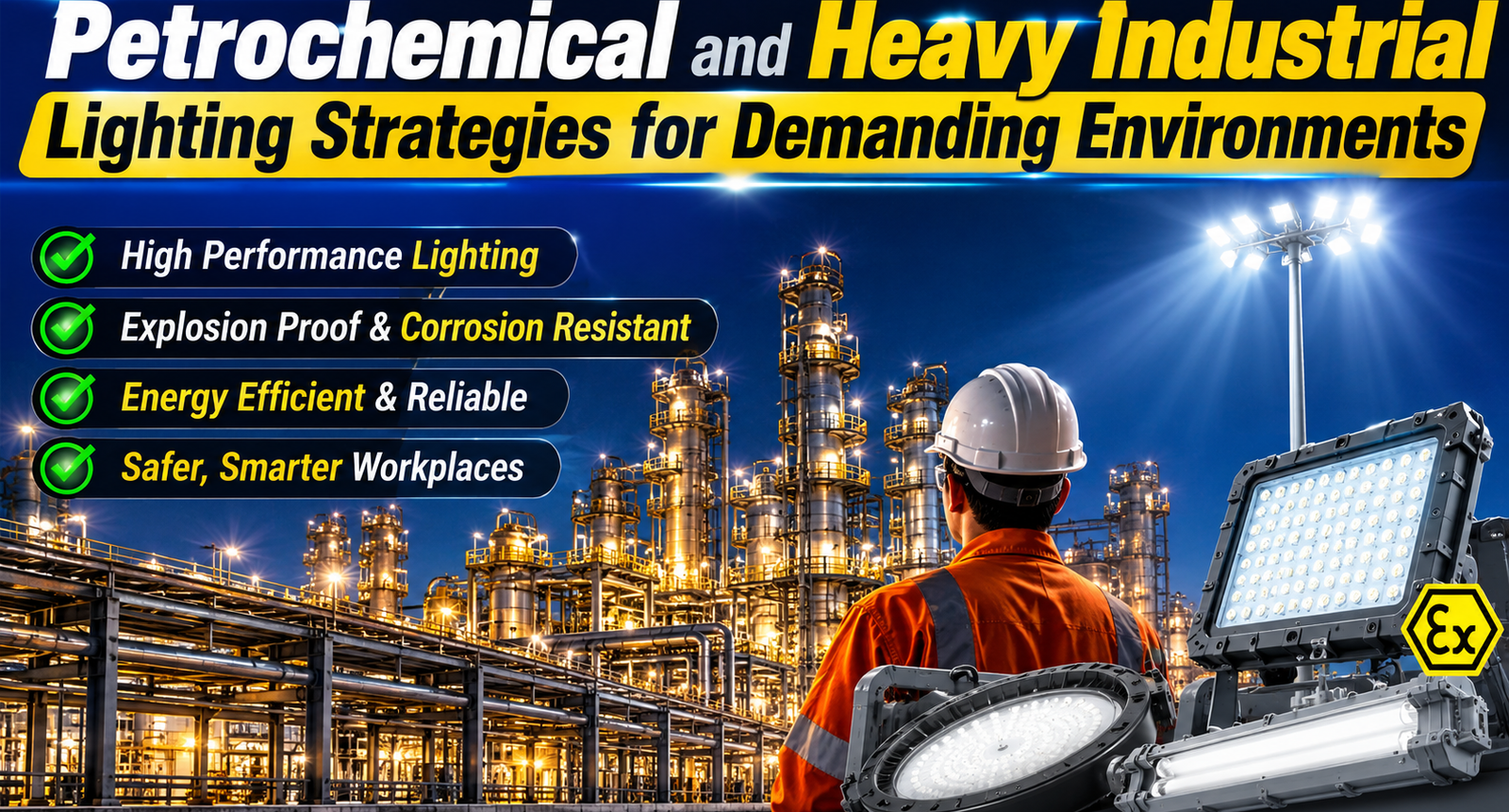
Petrochemical and heavy processing facilities occupy a distinct category within industrial lighting specification, largely because the operational environment itself — flammable vapours, Oil Refinery Industrial Lighting Assam, high-temperature process equipment, and safety protocols that go well beyond standard industrial practice — shapes lighting decisions from the ground up rather than being an afterthought layered onto a general industrial design.
Safety Rules for Lighting in Highly Sensitive or Hazardous Zones
Oil Refinery Industrial Lighting Assam installations operating near processing units, storage tanks, or loading areas where flammable vapours may be present typically fall under hazardous-area electrical classification requirements that dictate specific fixture design — explosion-proof or intrinsically safe enclosures rated for the specific hazard classification zone the fixture will be installed in. This isn’t a specification detail that can approximate or substitute with a standard industrial-grade fixture, even a high-quality one; hazardous-area certification is a distinct engineering and regulatory category, and facility safety teams should verify actual certification documentation for the specific zone classification present at their site rather than accepting a general assurance that a fixture is “rugged” or “industrial-grade.”
Selecting Durable, Weather-Resistant Materials for Harsh Processing Conditions
Beyond the hazardous-area classification question, petrochemical and heavy processing sites subject lighting infrastructure to a combination of environmental stresses — process heat, chemical vapour exposure, and in many cases genuine weather extremes depending on the region — that demand materials selected specifically for this combined stress profile. High Mast Light Pole Suppliers Assam serving refinery-adjacent sites need to account for Assam’s high humidity and rainfall alongside the process-specific stresses of the facility itself, meaning corrosion protection specifications discussed elsewhere in this series for humid regions apply here on top of, not instead of, the hazardous-area and chemical-resistance requirements specific to petrochemical operations.
Setting Up Routine Inspection Schedules to Avoid Outages
Processing plants generally cannot tolerate unplanned outages in safety-critical lighting zones, given how directly visibility affects safe operation of hazardous processes. Industrial High Mast Tower Suppliers Odisha and Industrial High Mast Tower Suppliers Chhattisgarh serving these facilities typically work within maintenance protocols considerably more rigorous than a general industrial estate would require — scheduled inspection at defined intervals, redundant lighting coverage in the most safety-critical zones so a single fixture failure doesn’t create a genuine dark spot, and rapid-response maintenance agreements given how quickly an unaddressed lighting gap in a hazardous zone can escalate from a minor issue to a genuine safety concern.
Coordinating Maintenance Access With Active Process Operations
Unlike a standard industrial yard, maintenance access near active petrochemical processing equipment often requires formal permit-to-work procedures, gas testing, and coordination with process safety teams before any maintenance work — including something as routine as replacing a luminaire — can proceed. This adds genuine time and procedural overhead to what would a simple task at a lower-risk facility, and lighting contractors working in this sector need to understand and respect these procedures rather than treating them as bureaucratic friction to minimize. Contractors experienced in petrochemical facility work build this permit and coordination time explicitly into their maintenance response planning, rather than assuming standard industrial access speed applies.
Thermal Considerations Near High-Temperature Process Equipment
Lighting fixtures positioned near furnaces, distillation units, or other high-temperature process equipment face a genuine thermal design challenge beyond standard ambient temperature ratings — radiant heat from the process itself can push a fixture’s actual operating temperature well above what the surrounding air temperature alone would suggest. Fixture placement and thermal rating for these zones needs to account for this radiant heat contribution specifically, rather than relying on a standard ambient-temperature rating that assumes no significant nearby heat source.
Vendor Qualification for Hazardous-Area Lighting Contracts
Given the safety stakes involved, facilities specifying hazardous-area lighting increasingly require contractors to demonstrate prior documented experience with hazardous-area installations specifically, rather than accepting general industrial electrical experience as an equivalent qualification. Contractors bidding on this work should prepare to provide references from comparable hazardous-area projects, along with evidence of staff training specific to permit-to-work and gas-testing procedures common at petrochemical sites, since facility safety teams increasingly treat this as a genuine qualification gate rather than a formality.
Long-Term Corrosion Monitoring for Refinery-Adjacent Infrastructure
Given the combined corrosion pressures of process chemical exposure and, in Assam’s case, sustained regional humidity, Industrial High Mast Tower Suppliers Chhattisgarh and comparable suppliers serving refinery-adjacent sites nationally increasingly recommend periodic coating condition assessments beyond the standard visual inspection — checking for early-stage coating breakdown at weld points and high-stress structural areas before it progresses to structural steel corrosion. Catching coating degradation early, while it can still address with localize recoating rather than structural remediation, meaningfully extends the effective service life of pole infrastructure in these demanding combined-exposure environments.
Emergency Response Planning for Lighting Failures Near Hazardous Zones
Beyond routine maintenance, facilities should have a document emergency response procedure specifically for lighting failures in hazardous or safety-critical zones — who to notify, what interim safety measures apply while a repair is arrange, and how quickly a qualifie technician with appropriate hazardous-area clearance can dispatch. Facilities that treat this as an ad hoc, figure-it-out-when-it-happens situation generally experience longer effective downtime in safety-critical zones than those with a pre-established emergency response protocol, since the permit-to-work and gas-testing coordination discussed earlier in this article still applies even during an emergency repair, and having that coordination pathway pre-established saves valuable time precisely when it matters most.
Documentation Standards for Ongoing Regulatory Compliance
Petrochemical facilities typically operate under periodic regulatory safety inspections that specifically examine lighting adequacy in classified hazardous zones as part of the broader facility safety audit. Maintaining organized, up-to-date documentation of fixture certifications, inspection records, and any modifications made to lighting infrastructure over time considerably simplifies these regulatory inspections compared to facilities that need to reconstruct this history from scattered records when an inspector actually requests it. This documentation discipline is, in practice, as much a part of maintaining a compliant facility as the physical lighting equipment itself.
What Facility Engineers Should Verify Before Specifying Petrochemical Lighting
Facility engineers and operations managers specifying lighting for refinery or heavy processing environments should confirm:
- Actual hazardous-area certification documentation matched to the specific zone classification at their site, not general assurances of ruggedness
- Combined environmental and process-specific material resistance appropriate to both the regional climate and the facility’s chemical and thermal exposure
- Redundant coverage in safety-critical zones to avoid single-point lighting failures
- Realistic maintenance access timelines that account for permit-to-work and gas-testing procedures
- Thermal ratings that account for radiant heat from nearby high-temperature process equipment, not just ambient air temperature
Frequently Asked Questions
What is the difference between explosion-proof and intrinsically safe fixture ratings? Both are approaches to hazardous-area electrical safety, but they work through different engineering principles — explosion-proof enclosures contain any internal ignition source safely within the housing, while intrinsically safe designs limit electrical energy to levels too low to ignite a hazardous atmosphere in the first place; the correct choice depends on the specific hazard classification and equipment type involve, and should be confirmed with a qualifie hazardous-area electrical engineer for the specific site.
How does permit-to-work coordination typically affect maintenance response time at a petrochemical facility? Response times for even routine maintenance tasks are generally longer at petrochemical facilities than at standard industrial sites, given the safety procedures involved, and facility maintenance planning should build this reality into service level expectations rather than assuming standard-industrial response speed.
Should contractors without prior hazardous-area experience exclude from bidding entirely? Most facilities don’t exclude new contractors outright, but they do typically weigh demonstrated hazardous-area experience heavily in technical evaluation, and a contractor without this specific background should expect to provide more extensive support documentation and possibly a supervise trial period before being fully qualified for unsupervised hazardous-zone work.
Petrochemical lighting will always demand more procedural discipline than a standard industrial installation, and operations managers who build that discipline into their vendor selection and maintenance planning from the start avoid the compounding safety and compliance risks that shortcuts in this sector eventually produce. The relatively small additional cost of properly certified hazardous-area equipment and appropriately trained contractors is, without exception, dwarfed by the potential cost of a safety incident traced back to inadequate lighting specification.
Learn more about HighMast India’s approach to demanding industrial environments on the About page.