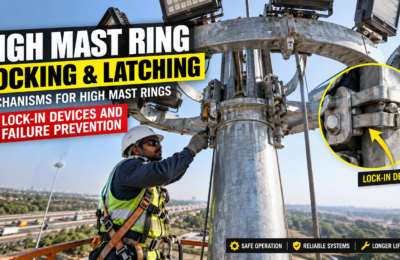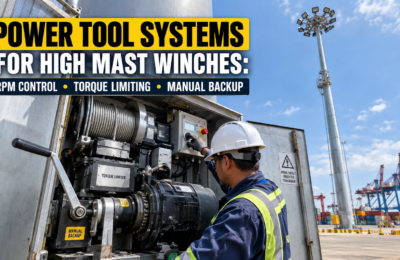
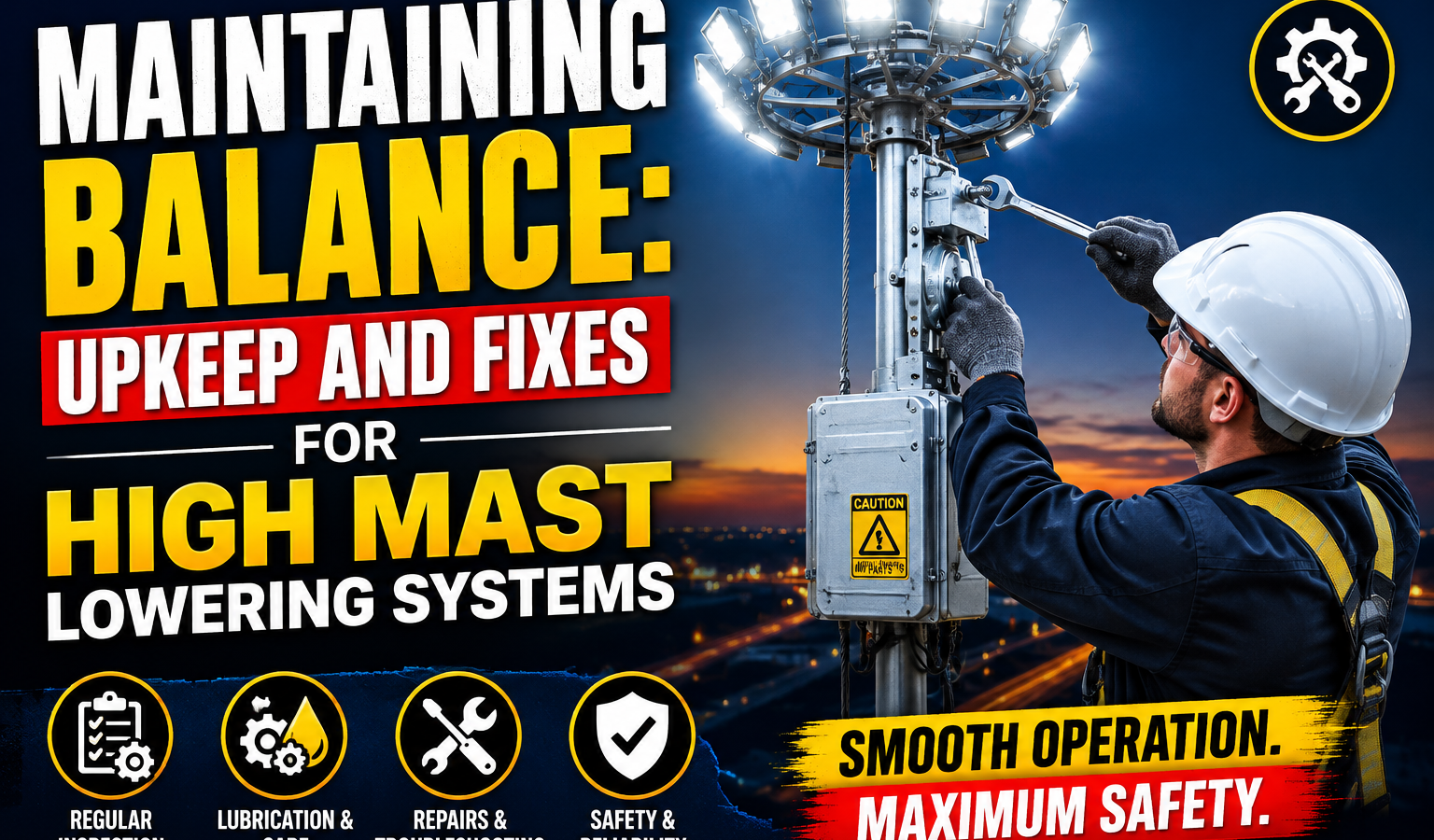
The lowering ring mechanism is, in a very real sense, the single most mechanically complex component on an otherwise simple structure. A high mast pole itself is essentially a static steel column, but the motorized system that raises and lowers the luminaire array for maintenance access involves wire ropes, winches, guide systems, and electrical control components that all need to work in precise coordination — and unlike the pole itself, these are moving mechanical parts subject to wear in ways that operations managers across Punjab, Goa, Kerala, and Assam need to actively plan for rather than assume will simply keep working indefinitely.
Inspecting Steel Wire Ropes and Winches for Wear
The wire ropes that raise and lower the luminaire ring are subject to continuous tension cycling every time the mechanism operates, and like any cable under repeated load, they eventually show wear — individual strand breakage, corrosion, or fraying at points where the cable runs over pulleys or guide wheels. Motorized Lowering Ring Mechanism Repair Amritsar and Motorized Lowering Ring Mechanism Repair Punjab service calls frequently trace back to a wire rope that had been showing early warning signs — visible fraying, inconsistent tension, or unusual noise during operation — for some time before a full failure prompted the service call. Operations teams that build a basic visual wire rope inspection into their regular maintenance rounds, rather than waiting for an operational failure, catch this kind of wear well before it becomes a safety-critical failure during an actual lowering operation.
Comparing Manual Hand-Cranks With Motorized Systems
Older high mast installations, and some lower-budget projects even today, use manual hand-crank lowering systems rather than motorized winches. While a manual system has fewer electrical components that can fail, it also demands considerably more physical effort and time from maintenance crews, and manual systems are generally slower to bring a full luminaire array safely to ground level compared to a motorized system operating at a controlled, consistent speed. For facilities weighing whether to upgrade an older manual system, the calculation typically comes down to how frequently the pole needs servicing and how much crew time cost matters relative to the upfront cost of a motorized retrofit — a rarely serviced pole in a low-labour-cost context may not justify the upgrade, while a frequently serviced pole at a busy facility often will.
Essential Safety Rules for Ground-Level Servicing
Whether manual or motorized, lowering the full luminaire array to ground level for servicing introduces its own safety considerations that maintenance crews need to follow consistently. The lowering operation itself should always be conducted with a clear exclusion zone beneath the descending array, since a partial mechanism fault during lowering — while rare with well-maintained equipment — represents a genuine risk to anyone standing directly underneath. Crews should also verify that the mechanism has fully locked at ground level before beginning any luminaire servicing work, rather than assuming the lowering process is complete simply because the array has visually reached the bottom of its travel.
Winch Repair Considerations in Coastal Environments
High Mast Winch Repair Services Kochi work has to account for the accelerated corrosion risk that coastal, high-humidity environments present to winch mechanisms — much as discussed for structural steel elsewhere in this series, but arguably more critical here given that winch components are precision moving parts rather than static structural elements. Salt-laden air and high ambient humidity can affect winch gearing and bearing surfaces measurably faster in coastal Kerala than the same equipment would degrade in a drier inland climate, which is why coastal winch maintenance schedules typically call for more frequent lubrication and corrosion-inspection intervals than an equivalent inland installation would need.
Lowering Gear Maintenance in High-Humidity Northeast Conditions
Lowering Gear Mechanism Repair Assam service work faces a related but distinct challenge: Assam’s combination of high rainfall and sustained humidity throughout much of the year creates persistent moisture exposure for lowering mechanism components, even without the direct salt exposure a coastal facility experiences. Gear mechanisms in this climate benefit from moisture-resistant lubricants and more frequent seal inspection on the mechanism housing, since standard lubricants and seals designed for drier climates can degrade faster under Assam’s sustained humidity conditions than their rated service life would otherwise suggest.
Goa’s Combined Coastal and Tourism-Season Considerations
Lowering Ring Mechanism Repair Goa projects face both the coastal corrosion considerations common to Kerala and a unique operational timing challenge: much of Goa’s public and commercial lighting infrastructure serves peak demand during the tourist season, which limits the practical maintenance windows available without disrupting facilities or public areas during their busiest period of use. Maintenance teams serving Goa’s coastal lighting infrastructure typically schedule more intensive mechanism servicing during the quieter off-season months specifically to avoid conducting disruptive maintenance work during peak tourism periods.
Building a Preventive Maintenance Schedule for Lowering Mechanisms
Regardless of region, a well-structured preventive maintenance approach for lowering mechanisms generally includes: scheduled visual wire rope and cable inspection at defined intervals; periodic lubrication of winch gearing and moving parts, adjusted in frequency for local humidity and corrosion conditions; functional testing of the full raise-and-lower cycle rather than assuming the mechanism works simply because it operated correctly the last time it was used; and documented service records that allow a maintenance team to track component wear trends over time rather than treating each inspection as an isolated event disconnected from the mechanism’s service history.
Training Maintenance Crews on Mechanism-Specific Procedures
Lowering mechanisms from different manufacturers can have meaningfully different operating procedures, safety interlocks, and typical failure patterns, and a maintenance crew trained generically on “high mast maintenance” without mechanism-specific training can miss warning signs that would be obvious to someone familiar with that particular system’s quirks. Facilities operating a mixed inventory of lowering mechanisms from different original suppliers — common at older estates or public infrastructure networks that have been built out in phases — benefit from either standardizing crew training across all mechanism types present, or maintaining a clear internal reference guide documenting the specific procedures for each mechanism type in the inventory.
Spare Parts Availability and Regional Service Networks
One of the most common causes of extended lowering mechanism downtime isn’t the repair itself but the wait for a replacement part — particularly for wire ropes, specific gear components, or control relays that aren’t standard, generic hardware. Facilities in less densely served regions, similar to the sourcing challenges discussed for Eastern India’s industrial corridors elsewhere in this series, benefit considerably from working with a supplier who maintains regional parts stock for common wear components, rather than each repair requiring a fresh order and shipping delay from a distant central warehouse.
Frequently Asked Questions
How often should a motorize lowering mechanism be functionally tested, not just visually inspect? A full functional test — actually cycling the mechanism through a complete raise-and-lower operation — is generally recommended on a more frequent schedule than a purely visual inspection, since some faults only become apparent when the mechanism is actually put through its full range of motion under load.
Can a damaged wire rope repair, or does it always need full replacement? Wire ropes showing significant strand damage or corrosion generally need full replacement rather than partial repair, since the load-bearing integrity of a wire rope depends on all strands sharing load evenly — a partially compromised rope is a safety risk even if it appears to still function.
Is it worth upgrading an older manual hand-crank system to a motorized mechanism, and what does that typically involve? For poles serviced frequently or where crew time cost is significant, motorized upgrades are often worthwhile; the retrofit typically involves replacing the winch and control components while reusing the existing wire rope guide structure where it remains in good condition, though a full mechanism inspection should confirm this before committing to the upgrade path.
When to Consider Full Mechanism Replacement Rather Than Repair
Older lowering mechanisms that have accumulated multiple repairs over their service life eventually reach a point where full mechanism replacement makes more economic sense than continuing to repair individual components as they fail. Facilities tracking service history through documented maintenance records are better position to recognize this inflection point objectively — a mechanism requiring frequent, escalating repair costs is signaling that its remaining components are likely approaching end of life together, even if no single component has yet cause a complete failure.
Lowering mechanisms are easy to overlook precisely because they work reliably for long stretches between failures, but that same infrequency of use is exactly why a scheduled inspection discipline matters — a mechanism that hasn’t test in months is not a mechanism you want to discover has fail only when an urgent repair actually requires it.
To discuss lowering mechanism maintenance contracts for your region, connect with HighMast India through the Products page.