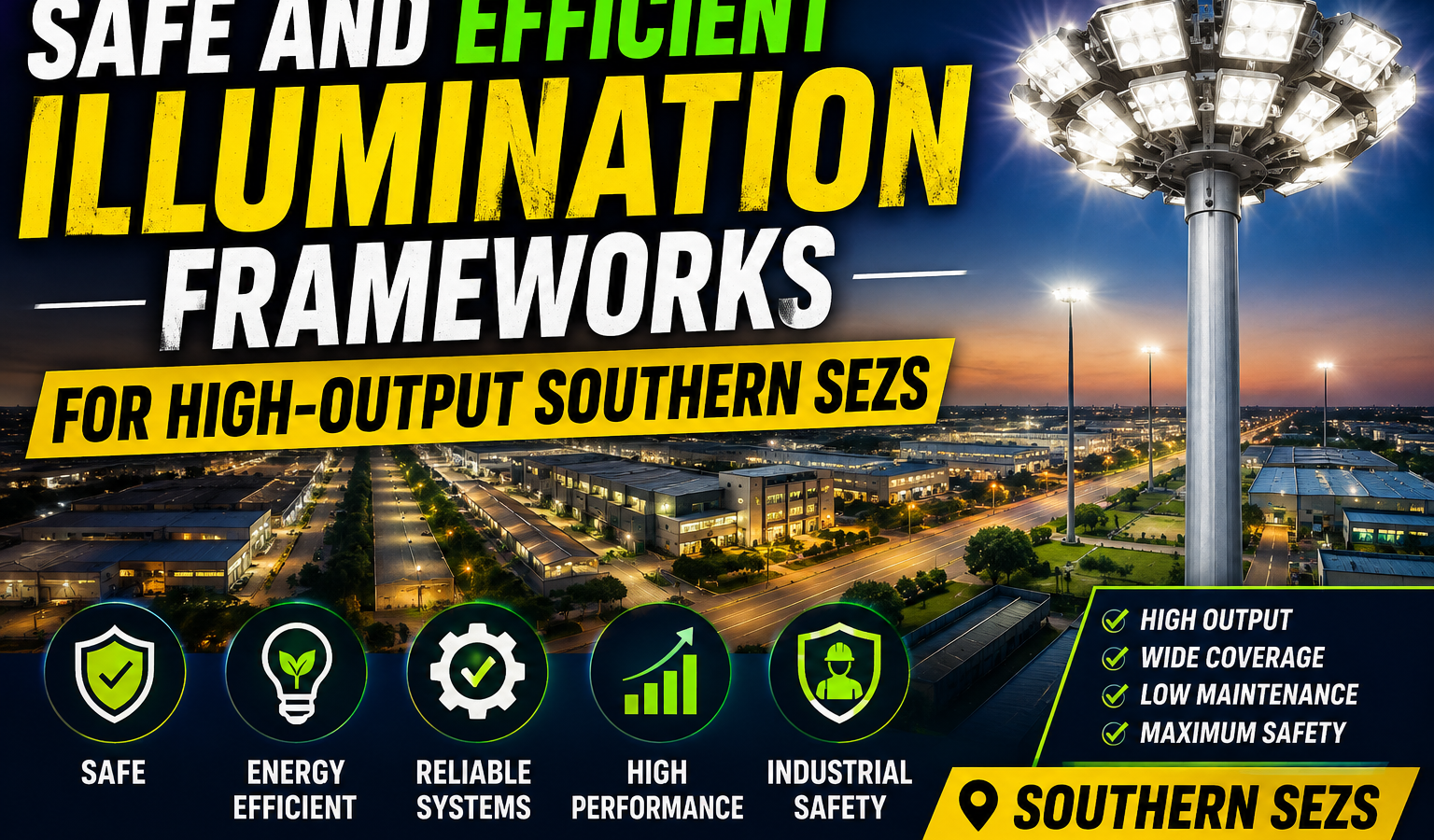
South India’s Special Economic Zones — Karnataka’s KIADB estates, Tamil Nadu’s SIPCOT parks, Andhra Pradesh’s APIIC zones, and Telangana’s TSIIC corridors around Hyderabad and Warangal, KIADB Industrial Area High Mast Maintenance— host some of the country’s most demanding manufacturing operations, from aerospace component fabrication to pharmaceutical production to precision electronics assembly. For procurement agents sourcing lighting infrastructure for these facilities, the specification bar sits considerably higher than a typical industrial estate, because the operations these SEZs support are themselves held to exacting quality and safety standards.
Why High-Precision Manufacturing SEZs Need Different Lighting Specifications
A general engineering plant can tolerate reasonable variation in ambient lighting quality. A pharmaceutical production facility or an aerospace component line generally cannot — inconsistent lighting affects quality control visual inspection accuracy, and in pharmaceutical contexts, lighting specifications may even tie to regulatory clean-room compliance requirements. KIADB Industrial Area High Mast Maintenance contracts for plots hosting this kind of precision manufacturing increasingly specify tighter colour-rendering index requirements and more consistent lux uniformity than a standard industrial park baseline would call for.
Designing Glare-Free Outdoor Perimeters Near Precision Facilities
Beyond interior lighting quality, the outdoor perimeter and yard lighting surrounding precision manufacturing facilities has its own specific challenge: minimizing glare and light spill that could interfere with sensitive optical or electronic testing equipment sometimes located near building perimeters or loading areas. SIPCOT Industrial Plant Lighting System projects serving electronics and precision component plots have adopted more tightly controlled beam angle specifications for exactly this reason — a standard wide-throw industrial floodlight that would be perfectly adequate for a general warehouse can actually create measurable interference issues near sensitive testing or clean-room adjacent outdoor areas.
Calculating ROI on LED Retrofitting for Multi-Acre Industrial Campuses
Large SEZ campuses — and TSIIC and APIIC zones in particular tend to host expansive multi-building campuses rather than small individual plots — represent a meaningfully different retrofit economics calculation than a single-building facility. APIIC Industrial Area Lighting retrofit projects covering dozens of high mast poles across a sprawling campus see a much larger absolute energy savings from LED conversion than a small plot would, which typically makes the payback period calculation more favourable and easier to justify to campus-level capital budget committees.
Facility operators evaluating retrofit ROI across a multi-acre campus should model the calculation at the campus level rather than extrapolating from a single-pole cost comparison, since campus-scale conversion projects also typically secure better per-unit equipment pricing than smaller, piecemeal purchases.
Preventative Maintenance Through Monsoon-Heavy Seasons
South India’s SEZ regions — particularly coastal Andhra Pradesh and parts of Telangana and Tamil Nadu — experience substantial monsoon rainfall that puts real stress on outdoor electrical infrastructure if maintenance schedules aren’t adjusted seasonally. TSIIC Industrial Plant Lighting Hyderabad and High Mast Pole AMC Services Warangal contracts increasingly build a pre-monsoon inspection cycle into their annual maintenance planning — checking enclosure seals, drainage around foundation bases, and earthing continuity before peak rainfall season, rather than waiting for a monsoon-triggered fault to prompt reactive repair.
This pre-monsoon inspection discipline has proven to measurably reduce monsoon-season outage incidents at facilities that have adopted it consistently over multiple years, compared to facilities still running a purely reactive maintenance model.
Vendor Qualification Standards for Precision-Manufacturing SEZ Contracts
Because SEZ facilities hosting aerospace, pharmaceutical, or precision electronics operations frequently carry their own internal quality and security accreditation requirements, lighting contractors bidding on KIADB Industrial Area High Mast Maintenance or TSIIC Industrial Plant Lighting Hyderabad work often need to demonstrate more than standard electrical contractor credentials. Some SEZ tenants require contractors and their installation crews to undergo facility-specific security clearance before being permit access to sensitive campus areas, and photometric commissioning reports may need to deliver in a format compatible with the tenant’s own internal quality audit documentation. Contractors unfamiliar with this additional qualification layer sometimes discover it only after winning a bid, which can delay project mobilization; building this expectation into the original tender response avoids that friction.
Integrating Lighting Control With Campus-Wide Building Management Systems
Larger SEZ campuses, particularly TSIIC and APIIC multi-building sites, increasingly run centralized building management systems that control HVAC, security, and power distribution from a single monitoring platform. Lighting infrastructure that can report status and accept remote control commands through a compatible protocol integrates far more smoothly into this kind of centralized campus management than a stand-alone lighting control panel that operates in isolation. Facility teams planning new High Mast Pole AMC Services Warangal contracts should confirm early whether campus-wide BMS integration is a current or near-future requirement, since retrofitting communication compatibility into an already-installed control panel is generally more expensive than specifying it correctly from the outset.
Balancing Security Lighting Standards With Energy Efficiency
SEZ facilities, particularly those in aerospace and defense-adjacent manufacturing, typically operate under stricter perimeter security lighting requirements than general industrial estates — continuous, high-uniformity illumination along facility boundaries is often a stated security compliance requirement, not just a safety preference. Meeting these standards while still controlling energy costs requires careful luminaire selection and smart control integration — dimming or zone-based control systems that maintain full security-standard brightness in active zones while reducing output in lower-priority perimeter sections during low-risk periods, for facilities where security protocols allow this kind of graduated approach.
What SEZ Procurement Teams Should Specify
Procurement teams sourcing lighting infrastructure for KIADB, SIPCOT, APIIC, or TSIIC precision manufacturing plots should specify:
- Colour-rendering index and lux uniformity standards appropriate to the specific manufacturing or clean-room activity on each plot
- Tightly controlled beam angle specifications for perimeter and yard lighting near sensitive testing areas
- Campus-level retrofit ROI modelling for multi-building SEZ facilities rather than single-pole cost comparisons
- Pre-monsoon inspection protocols built into annual maintenance contracts for coastal and high-rainfall SEZ regions
South India’s precision-manufacturing SEZs operate at a standard that general industrial lighting specification simply doesn’t meet, and procurement teams that treat lighting as a precision-engineering decision — rather than a commodity purchase — consistently see better long-term operational and compliance outcomes. To discuss precision-manufacturing lighting specifications for an SEZ facility, connect with HighMast India through the Industries page.
Documenting Compliance for Multi-Tenant Campus Audits
Large SEZ campuses hosting multiple tenant companies under a single estate management structure frequently need to satisfy each tenant’s own internal audit requirements alongside the estate’s baseline compliance standard. SIPCOT Industrial Plant Lighting System estate managers have increasingly adopted a practice of maintaining a shared compliance documentation portal accessible to all campus tenants, reducing the duplicated effort of each individual tenant company requesting the same photometric and safety compliance records separately from estate management for their own internal audits.
Frequently Asked Questions
Pharmaceutical facilities often have internal quality and regulatory requirements tied to lighting consistency in production areas; outdoor high mast lighting isn’t usually subject to the same regulatory scrutiny as interior clean-room lighting, but campus-wide consistency is still commonly request facility quality teams.
How is glare interference with sensitive testing equipment typically assess before installation? A pre-installation lighting survey using the actual propose beam angle and mounting height data can model potential light spill into sensitive zones, allowing adjustments before poles are fabricated rather than discovering an interference issue after installation.
What is a reasonable timeline for a security clearance and vendor qualification process at a defense-adjacent SEZ facility? This varies by facility and the sensitivity of the specific campus, but contractors should generally expect the qualification process to add several weeks to a project timeline compared to a standard industrial estate contract, and should factor this into their tender response scheduling rather than treating it as a formality that happens automatically after contract award.
Does campus-wide BMS integration significantly increase the upfront cost of a lighting control panel? There is typically a modest incremental cost for communication-capable control panels compare to stand-alone units, but this is generally far lower than the cost of retrofitting communication capability into an already-installed panel later, making it a worthwhile specification even for campuses not yet running a full BMS platform.
Precision manufacturing SEZs will keep raising the bar on what “adequate” lighting means, and suppliers who treat these projects with the same rigor the tenant industries themselves apply to their own quality standards are the ones that build lasting relationships with campus procurement teams.